
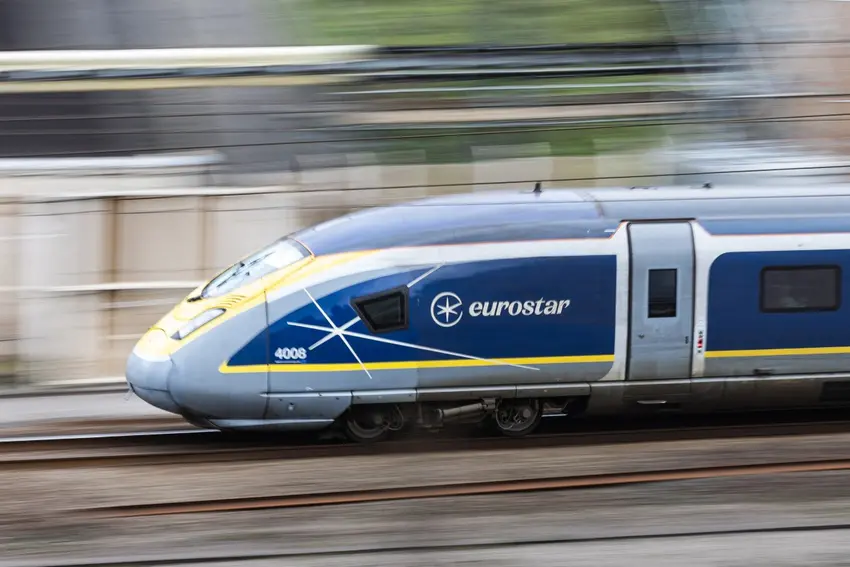
The London-Paris train service is a favourite with many travellers, but one thing it isn't, is cheap.
But there may be changes afoot, as other companies are set to enter the market - albeit not without problems of their own.
Despite the fact of press announcements from various companies about setting up in competition with the Eurostar, so far only the UK train company Virgin has secured regulatory approval to access HS1, the high-speed line connecting London with the Channel Tunnel.
Virgin is planning to launch international services from London to Paris, Brussels and Amsterdam from 2030. The company has proposed up to 20 daily return services. It has also secured access to Temple Mills, Eurostar's international maintenance depot in east London, giving it an important piece of the infrastructure needed to get its trains running.
READ ALSO: Will competition on French railways actually mean cheaper train tickets?
For the various other train companies hoping for a London-Paris route, negotiations are ongoing.
So with the caveat that Eurostar looks to be keeping its monopoly for another few years, what would a competing service look like?
Distinct identity
Marcus Mayers, a rail researcher who has recently written about Virgin's plans for The Conversation, told The Local that one of the biggest challenges for potential competitors "is not simply getting permission to run trains, but being able to stable and service them".
There has effectively been a race to secure the infrastructure needed to enter the market, he said, with Virgin now in a strong position after securing access.
Mayers believes Virgin will want to do more than simply copy Eurostar. That could mean different seating arrangements, more appropriate spaces for families, or areas designed around particular passenger needs.
“Virgin will want to differentiate itself and establish a distinct identity,” Mayers said, adding that Eurostar would then have to respond.
Competition could also bring more destinations. Virgin could eventually look beyond the core London-Paris route to destinations such as Lille and other French cities.
Mark Smith, a rail travel expert behind the train guide The Man in Seat 61, also mentioned that Trenitalia could start operating trains between London and Paris by 2029, and train company Gemini could also explore more stops in France and expand to Germany from London, like Cologne, for example.
Train stations and passport checks
There is another potential obstacle to all this extra competition - the stations themselves, and the requirements for passport control.
The London-Paris route crosses an external EU border, and since the end of the Brexit transition period this has resulted in increased passport checks - soon to increase again with the full introduction of the EU's biometric passport checks known as EES.
Although passport checks were always required, the extra requirements of passport stamping have significantly increased check-in time and have led to Eurostar advising passengers to arrive an hour or more before their train leaves.
If you've travelled from London to Paris, you may have noticed the overcrowded waiting area in Saint-Pancras and the very long queues at Paris' Gare du Nord.
St Pancras is already struggling with the growing number of international passengers, with Eurostar trains carrying up to almost 900 people. Plans are under way to redesign the terminal, including changes intended to increase security-processing capacity and reduce waiting times - although they will not be completed for years.
Mayers explained that the biggest constraint on adding more Channel Tunnel services is not the trains themselves, but the stations.
“You can get trains in and out quite quickly,” he said, but the problem is what happens to the passengers once they arrive at the station. The current system of passport and security checks was not designed for the volume of international rail travel now being handled.
St Pancras in particular was designed around a very different border-control system. Mayers, who worked at Eurostar in the 1990s, said the way immigration checks were originally established was different from today's system. The introduction of more extensive checks has effectively made passenger flow through the station a bigger constraint.
He believes that Virgin's arrival could put pressure on the whole system to improve.
So, will we get cheaper Eurostar tickets?
The economics of international rail are very different from those of domestic French high-speed trains - Channel Tunnel operator GetLink charges companies for using the tunnel, using the fees to cover the costs of maintenance and security in the 50km undersea tunnel.
According to Jon Worth, an independent railway commentator, the cost to operators of the tunnel fee works out at around €17 per passenger - in addition to all the usual expenses for train operators such as the cost of the train itself, maintenance, energy and staff wages.
He said competition could eventually mean cheaper Eurostar tickets, but probably not a “Ryanair train”, partly because of the cost of using the Tunnel.
Instead, he expects competition to “drive up the number of trains, reduce the prices a bit” and improve onboard service.
Mayers also cautioned against assuming that competition automatically means dramatically cheaper tickets. Virgin could put pressure on Eurostar even if its fares are not always lower, by offering a different product and giving passengers another reason to choose one operator over the other.
The market could therefore become bigger rather than simply being divided between Eurostar and Virgin.
Mayers believes competition will “sharpen” both companies and could lead to more destinations, more creative train designs and different types of passenger experience.
Comments