

First things first, it’s important to note that applying for Spain’s digital nomad visa is not easy and it can be tricky to do by yourself without seeking professional legal help.
Basically, there are two ways to apply, the first is from your home country via an embassy or consulate and the second is to apply when in Spain. The first option gives you one year residency, which you can then renew and extend, while the second option gives you three years up front. Again, you can renew and extend for a further two years.
This means that there are different application forms available depending on the route you take. If you apply through your home country, the Spanish embassy or consulate will typically have its own application form. It’s important to note that this will be different from the one you should use if you're applying from in Spain while you're here as a tourist.
For the purposes of this article, we will be talking about the application form when applying from Spain, as consulates can differ on their forms and information.
READ ALSO: Spain's new income requirement for digital nomads in 2024
It's important to note that the application will not be the first step, you will need to first make sure you meet all the requirements, then gather all your supporting documents and get them translated. Only then will you actually fill out the form and submit it.
Firstly, finding the application form is not easy in itself, links are hidden within pages of Spanish legalese and there’s no clear ‘apply here’ button on the Spanish government website or the Unidades de Grandes Empresas (UGE), the body where you submit your application. Also, the links to the forms often change, so you may find that once you finally find the link to the form, it’s broken.
Spanish digital nomad Facebook groups can be helpful to find updated links if this happens.
Secondly, it’s not just about the application form, there are so many supporting documents and pieces of evidence you need to provide.
Spanish bureaucracy is notoriously difficult and convoluted and it’s very easy to make several mistakes along the way. This could cost you and could cause your visa to be denied.
If you're unsure about anything to do with the process, it's advisable to seek the services of a lawyer or consultant who knows what they're talking about.
Be aware though, as the visa is still new, many lawyers are still getting to grips with the process and don't fully understand it yet themselves. It's best to get recommendations from others who have already applied.
READ ALSO: What are the pros and cons of Spain's digital nomad visa?
It’s important to know that in order to send the application yourself without professional help, you will need access to a digital certificate. This is a piece of software downloaded onto your computer to help you officially identify yourself during online processes.
But, in order to get this, you will need an NIE number, which can be found on your TIE residency card. You probably won’t have this number yet, as you will apply for it at the same time as your visa.
This means that you will need access to someone else's digital certificate in order to send the form and find someone within Spain who is willing to share this with you. This can be tricky because it contains a lot of important personal information, and unless you know the person really well, they will be unlikely to share it with you.
This again is another reason that people get professional help, so that lawyers can submit the application on your behalf, using their digital certificates.
If you are able to get hold of a digital certificate and want to and complete the application yourself here's what to do.
Go to the UGE website in order to send your application. It’s here that you will have to use either a digital certificate or cl@ve pin to gain access and start the application process.
Once you have you will be able to complete and send the following application form.
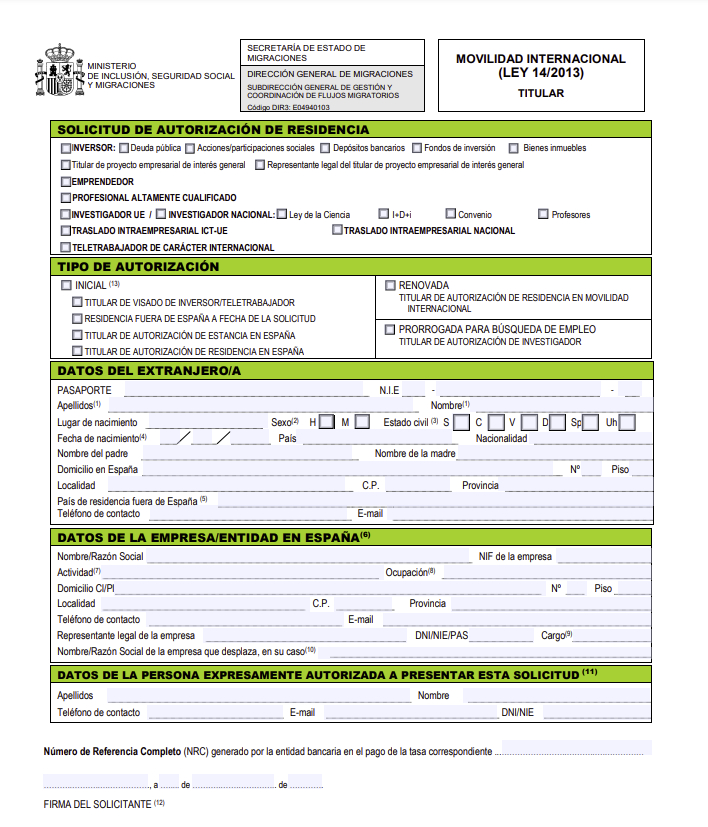
It’s all in Spanish, so unless you speak Spanish well, it’s important to get someone to help you who understands.
1. Under the first section (Solicitud de Autorización de Residencia) you should check the box that says teletrabajador de carácter internacional, which refers to the digital nomad visa.
2. Under the second section where it says Tipo de Autorización or Type of Authorisation you should tick the box that says Inicial (initial) if this is your first time applying for the visa and you are not renewing it.
3. In that section, you will again check the box for Titular de Autorización de Estancia en España if you are already here on some type of tourist visa.
4. Next you will complete all your personal details such a passport number, name, date of birth, place of birth, nationality, name of parents and address in Spain.
5. The fourth section is only for those applying for a residence permit for a highly qualified professional, researcher, or being transferred by your company. Just leave this blank.
6. The last section should be completed by the professional submitting your application for you or the person who’s digital certificate you are using and will send it on your behalf.
7. Finally you will need to sign and date the form.
Don’t forget you will also need to complete form 079 Tasa038 in order to pay your application fee. This is currently €73,26.
READ MORE: How to pay the fee for Spain's digital nomad visa
You can also do this by using a digital certificate here.
You will also need to send several supporting documents with your application, which you can find a full list of here.
Make sure to also check The Local Spain's extensive coverage of news and practical information for digital nomads.
Comments