
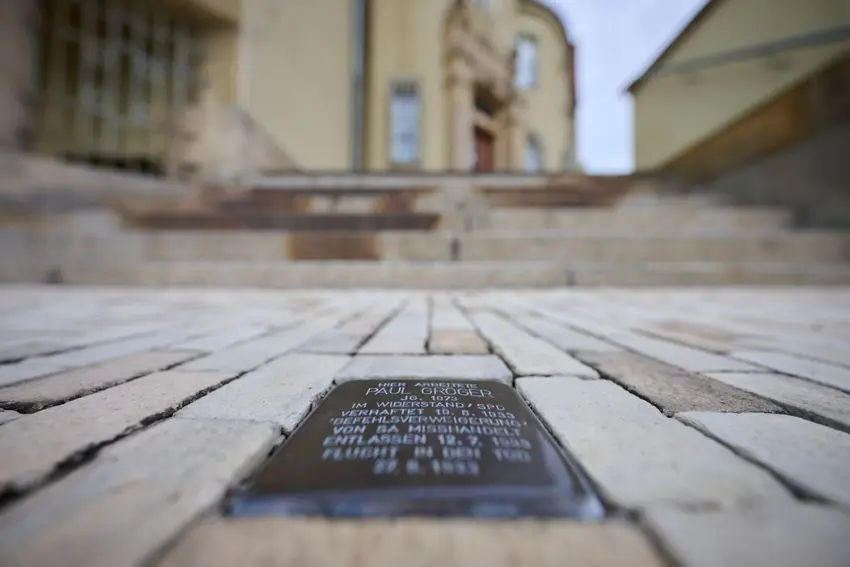
In Heidenau, near Dresden in the German state of Saxony, the city council decided last week that no further "stumbling stone" memorials to the victims of National Socialism are to be laid in public streets and sidewalks going forward.
On Thursday, September 24th, the city council passed a corresponding motion by the far-right Alternative for Germany (AfD), the conservative Christian Democrats (CDU) and the Upper Elbe citizens' initiative.
The resolution says: "Laying of 'stumbling stones' in the public road and sidewalk area will be rejected in the future."
The motion was decided by secret ballot in which 13 members voted yes, six voted no and one abstained.
What are Germany's Stumbling Stones?
Stumbling stones, known as Stolpersteine in German, are small metal plaques designed to fit into the cobblestone sidewalks that are common in Germany.
Each bears the name of a victim of Holocaust, as well as their date of birth and often also the date that they were killed in a concentration camp by the National Socialists. In other cases stones may note the date that a person fled the country, or was released from a concentration camp, if they survived.
For example, one stone laid in Cologne-Zollstock reads: "Hier wohnte CARL NEUGARTEN. JG 1885. Deportiert 1944, Theresienstadt. Ermordet 11.12.1944."
This translates as: "Here lived Carl Neugarten. Born 1885. Deported to Theresienstadt in 1944. Murdered [there] on December 12th, 1944."
The stones are placed in front of the building or address where the victims were known to have lived up until they were removed by Nazi forces, or were forced to flee.
READ ALSO: Stolpersteine - Standing defiantly in communities amid rising tensions
The project was started by German artist Gunter Demnig in the 1990s, who laid the first stones and created a process by which people can petition to have a Stolperstein installed -- provided that a Holocaust victim's name, year of birth, last address of choice and ultimate fate can be verified.
Funding for the stones usually comes from private donations.
There are now at least 128,000 stumbling blocks laid in cities and towns across Germany, as well as in 30 other countries that were affected by the Nazi regime.
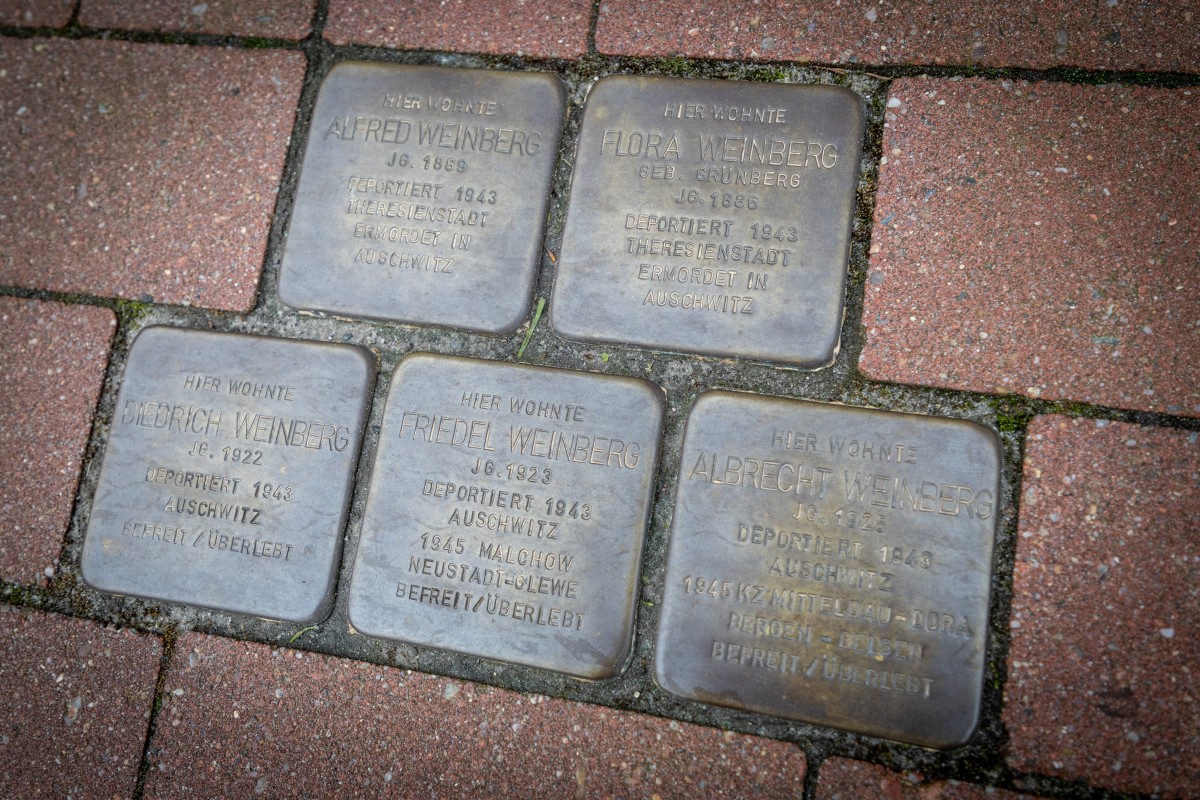
Taken together they are widely recognised as the world's largest decentralised memorial, and are a significant part of Germany's culture of active remembrance (Erinnerungskultur).
Why block more stumbling stones?
According to the motion brought by local AfD and CDU politicians in Heidenau, commemoration of victims of the Nazis in the "public road and sidewalk area" is not appropriate.
Proponents of the motion argue that the names of victims should not be placed where they can be stepped on by passer-bys. They suggest that instead memorials and commemoration should be centred in the city's North Cemetery.
But the move appears to be aligned with the AfD's goal of curbing remembrance of the Holocaust.
The far-right party, which is classified as "confirmed right-wing extremist" by Germany's domestic intelligence agency in the state of Saxony, has referred to the established culture of remembrance of the Holocaust as a 'guilt cult.'
READ ALSO: Why the Alternative for Germany is considered a far-right extremist party
Ahead of the recent state election in Saxony-Anhalt, the party's regional deputy leader, Hans-Thomas Tillschneide, suggested that remembrance should be limited in schooling, adding that the balance should be "more Bismarck, less Hitler".
'A scandal'
The decision to ban stumbling stones in the small city of Heidenau was met by sharp criticism across Germany, including by leaders of the federal government.
Federal Education Minister Karin Prien, of the CDU, called the decision "a scandal."
She added, in comments to the Bild daily newspaper, that anyone who wants to limit places of remembrance of Jewish life to cemeteries makes Jews "invisible once again".
Green Party leader Felix Banaszak told the German Press Agency, that blocking stumbling stones based on the justification that they can then be stepped on is "absurd".
"They bring the names and fates of the victims into our everyday lives and ask us to pause for a moment," he said.
He added that the real scandal is that the memory of the victims of National Socialism is trampled underfoot by right-wing led motions, like that passed in Heidenau.
Criticism also comes from the Left Party and the Social Democrats (SPD) in the Saxon state parliament.
Calling on the city council to reconsider the decision, SPD state parliament member Albrecht Pallas said it's wrong to banish the culture of remembrance to the outskirts of the city. He accused the AfD of wanting to relativise National Socialism.
The motion in Heidenau is not the first time that the the stumbling stones memorial has been questioned.
In Munich, members of the Jewish community had previously questioned if the plaques should be placed on the ground to be stepped on. As a result the city no longer lays stones on municipal property, but instead adds plaques on house walls as a memorial in public space.
Speaking about the motion in Heidenau, Charlotte Knobloch, Holocaust survivor and president of the Jewish Community of Munich and Upper Bavaria, said that removing places of remembrance from the cityscape is the "completely wrong way" to address the issue. She told the Funke media group that she was "appalled that a democratic party would devote itself to supporting such a transparent manoeuvre by the extremists from the AfD."
For Gunter Demnig, initiator of the Stolperstein project, the move was not unexpected.
"After the election successes of the AfD, it was to be expected that something like this would happen," said the 78-year-old from Alsfeld in central Hesse.
He accused the CDU of having distanced itself from Christian values. The party "should perhaps delete its 'C'. Because they have left Christianity behind."
Comments (2)