
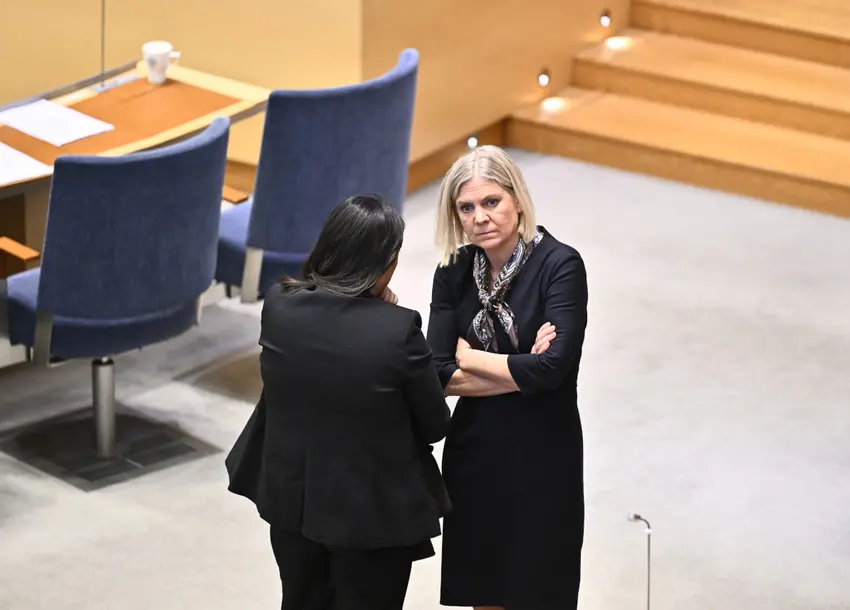
Magdalena Andersson, the left bloc's candidate to be Sweden's next prime minister, on Monday made the shock announcement that she was giving up the attempt to form a government.
Because the Left Party had decided to vote alongside the right-wing parties to keep the Moderate MP Andreas Norlén in place as speaker of the parliament, she argued, they had effectively created a new bloc.
"As the parliamentary situation has developed since the election, it is reasonable that the constellation that formed for the election of the speaker can move forward and try to reach an agreement on the government issue as well," she said.
Sarcastic?
Certainly. Andersson knows full well that the Left Party would never back a government headed by Moderate Party leader Ulf Kristersson with the support of the far-right Sweden Democrats.
If the Left Party succeeds in blocking a Social Democrat speaker, as seems likely, it will have deprived Andersson and her party of a useful tool in the coming talks. That would arguably benefit the Left Party, but also the parties on the right.
But spiteful and impulsive?
Andersson certainly has form. In the talks to form a government in 2018, she was reportedly seen as an obstacle by the Social Democrats' prospective government partners, an abrasive, unyielding player without the softer skills required of a good negotiator. It's not impossible she acted impulsively out of anger and frustration at the Left Party's refusal to toe the line.
Moderate leader Ulf Kristersson next in line
If, as is more likely, it is a strategy, it's certainly a high-risk one. Ulf Kristersson is next in line to be appointed sonderingsperson, the "sounding person" tasked with trying to build a government coalition.
As Andersson well knows, there's zero chance of him winning the support of the Left Party. But the same cannot be said of the Centre Party, which has never entirely ruled out backing or joining a right-wing government – even if it says that government can't include Sweden Democrat ministers.
By handing the reins to Kristersson, Andersson is now giving him a chance to win over the Centre Party and sneak into government. If he succeeds, she will have used up her last chance. There might be nothing she can now do to stop her rival becoming prime minister.
The reason it just might be a strategic masterstroke is that the Centre Party's leadership can only really justify joining a right-wing government with Sweden Democrat influence if it can tell its members and voters that it has exhausted every other option. It would have to argue that, despite long and hard negotiations, there was simply no viable alternative on the left.
By giving up almost before she started, Andersson has made this impossible, at least at this stage. Centre Party leader Elisabeth Thand Ringqvist cannot now claim – with any credibility anyway – that the four former opposition parties have done all they can to form a government and failed.
This means that if Kristersson is appointed sonderingsperson the chances are that he will either have to abandon talks just as Andersson has just done, or else the speaker will put his candidacy to the parliament and a majority of MPs will vote him down.
So if it all works out, the role will revert to Andersson, who might then be in a stronger position.
What happens next?
Left Party leader Nooshi Dadgostar has already described the decision to give up on forming a government as märklig, which in this context basically means "weird". But Andersson will have taken her by surprise and left many in her party genuinely worried. If they didn't before, they now know that they can't take a left-wing government for granted.
The Centre Party and Green Party, meanwhile, have rallied behind the Social Democrats, with Thand Ringqvist accusing the Left Party of choosing to leave "extremely constructive" talks over the speaker, and Green Party leader Daniel Helldén accusing the Left Party of "making the process more difficult".
If the baton is eventually passed back to her, Andersson would also be starting talks after Kristersson has himself failed to build a government.
So what happens next? Will Kristerson manage to make the Centre Party an offer they can't refuse and as a result win another term as PM? If so Andersson will have made a historic blunder.
Or will he fail, allowing her to resume negotiations with a chastened Left Party? If so, it might be a clever, curveball first move in what are likely to be long-drawn-out government negotiations.
We shall see.
Politics in Sweden is The Local's weekly analysis, guide or look ahead to what's coming up in Swedish politics. Update your newsletter settings to receive it directly to your inbox.
Comments