
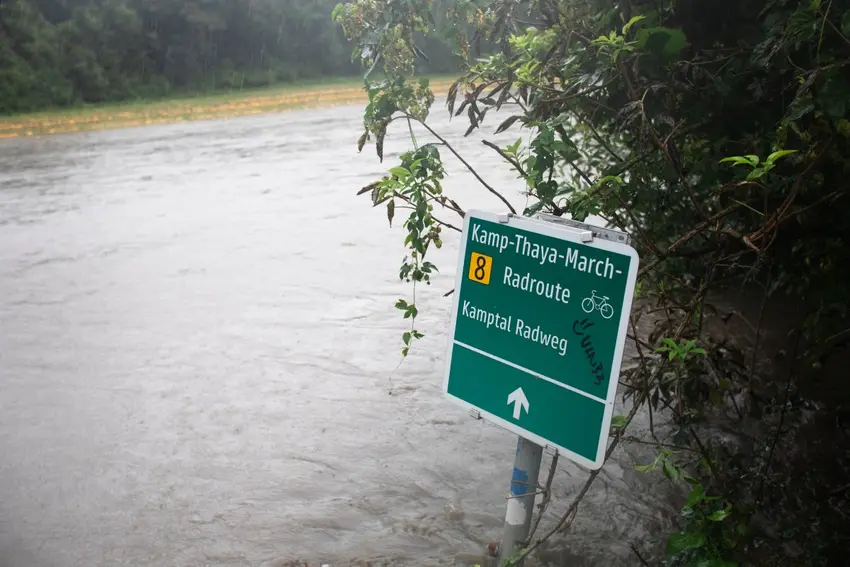
The September 2024 floods were among the most severe in Austria's recent history.
Six people died during the floods in Austria, five of them in Lower Austria, which was hit particularly hard.
Between the Mostviertel and Wienerwald, some areas received 300 to more than 400mm of rain in just five days - more than 5.5 times the long-term average for an entire September.
Across more than half of Lower Austria, the five-day rainfall total reached the statistical scale of an event expected around once in 1,000 years.
The disaster caused more than €1 billion in damage in Lower Austria.
Since then, millions of euros have gone into new flood defences, monitoring systems and emergency preparedness. But some of the deeper weaknesses exposed by the 2024 disaster, especially when it comes to where Austria allows homes to be built and how buildings are protected from extreme flooding, have yet to be addressed.
So what has Austria actually changed since then? The Local spoke with three experts to find out.
Dozens of new flood protection projects
In Lower Austria, some of the clearest changes are physical ones.
After the disaster, the province carried out an interdisciplinary evaluation. One of its conclusions was that existing flood-protection infrastructure had prevented even greater damage.
"The existing flood-protection systems made a significant contribution to preventing even greater damage," Martin Angelmaier, head of the Water Management Department of the Lower Austrian government, told The Local.
"For that reason, the recommendation was made to consistently continue expanding flood protection."
According to Angelmaier, 35 flood-protection projects with a total investment of around €141 million have been completed in Lower Austria since the 2024 floods.
Another 37 projects worth around €55 million have started, and work on a further 32 projects worth around €160 million is due to begin by the end of 2028.
But responsibility for these projects is relatively decentralised.
"In Austria, the decision on whether flood protection is built ultimately lies with the municipalities concerned," Angelmaier said.
"The state of Lower Austria and the federal government support the municipalities with funding and advice on project development and construction. But the municipalities or water associations are the project owners, and they are also responsible for operating and maintaining the protection systems."
READ ALSO:How Vienna’s restoration projects helped mitigate flood damage from Storm Boris
Forecasts are getting longer, and monitoring has expanded
Lower Austria has also expanded its forecasting systems.
Around 365 hydrographic monitoring stations now provide real-time information on rainfall, river discharge, water levels and groundwater levels through the province's website.
The province is also working to extend flood forecasts to as much as five days ahead and to develop new forecasting systems for important Danube feeders, including the Pielach, Perschling and Große Tulln.
Those projects are due to be completed in early 2027.
Other measures will help hold more water in the landscape instead of letting it flow downstream quickly.
New regulations are being prepared for another 15 waterways to preserve existing retention areas, Angelmaier said. The technical groundwork is complete, and the legal work is now underway.
The province has also taken steps to strengthen the organisations responsible for maintaining flood defences.
Disaster management is also changing.
Special municipal disaster plans are being developed, communications and alarm systems are being made more resilient, specialised equipment such as large pumps has been purchased, and staff and emergency responders have received additional training based on the experience of 2024.
"Overall, very significant recommendations have already been implemented, while some measures are currently being implemented," Angelmaier said.
"Lower Austria has drawn the necessary conclusions from the experience of the 2024 flood disaster and is therefore even better prepared for future floods."
But he also stressed that even extensive protection cannot eliminate the danger altogether.
"It is very important to emphasise that flood disasters of this magnitude can never be completely prevented and that residual risk will always remain."
READ ALSO:'Achtung... Gefahr': What do Austria's weather warnings actually mean?
Not everything labelled '2024+' was created after the flood
Dr Clemens Neuhold, deputy director of the federal Flood Risk Management directorate, drew a distinction between new measures and longer-running work.
After the disaster, Austria presented a 10-point programme called Zukunft Hochwasserschutz 2024+, or Future Flood Protection 2024+. But Neuhold cautioned against interpreting it as a package created solely in response to the September 2024 disaster.
"The 10-point action programme provides a long-term orientation and development framework for the entire water-engineering sector," he told The Local.
"It does not relate to one specific flood event, but to a forward-looking approach to every future flood event."
Some elements of the programme build on longer-running work.
Flood-protection systems are routinely evaluated, particularly after major events, while flood exercises are ongoing and Hydrographie 2030+ is a longer-term project. Neuhold said damage to flood-protection infrastructure caused by the floods has now been "largely repaired".
Austria also continues to invest heavily in conventional protection.
According to Neuhold, around €350 million to €450 million is invested in Austria in the construction, maintenance and planning of flood-protection measures, with the cost shared between the federal government, Länder and municipalities.
But getting money is not easy: "Additional financial resources are difficult to obtain given the currently strained budget situation," Neuhold said.
He did add that Austria was making extensive use of EU funding calls.
READ ALSO:Don't panic! What you need to know about Austria's national siren test
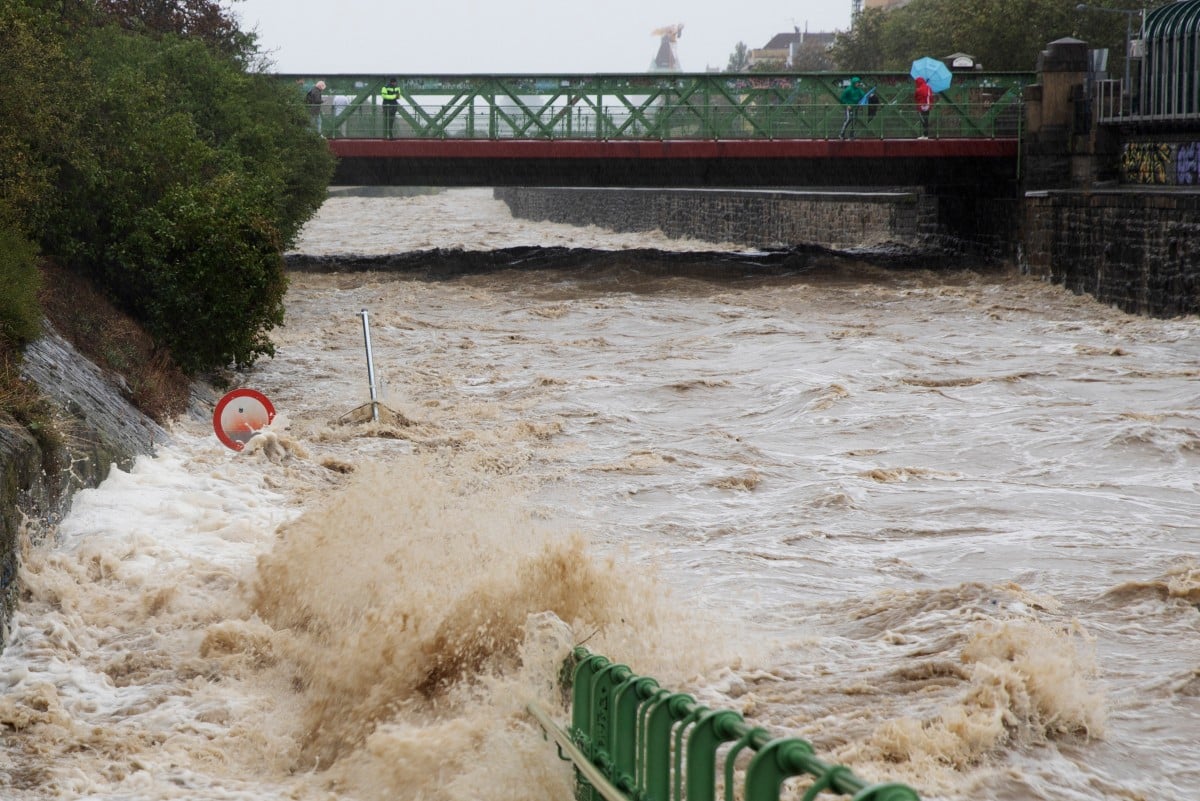
The bigger issue may be where Austria builds
Walter Seher, assistant professor at BOKU University's Institute of Spatial Planning, Environmental Planning and Land Rearrangement, said the disaster highlighted a long-standing problem.
Austria has relatively little land suitable for permanent settlement because of its mountainous geography. According to Seher, only around 38 percent of the country's territory is potentially usable for settlement.
Many buildings and infrastructure end up located in potentially flood-prone areas. Some are protected by dams, retention basins, river engineering or other technical measures up to a defined level of flooding.
But Seher said there are far fewer restrictions on development in areas exposed to rarer, more extreme events, or in areas considered protected by technical flood defences.
Areas behind technical flood defences are often described as "residual-risk" areas. "Such areas are therefore developed very intensively, generally without mandatory flood-adaptation measures on the buildings," Seher told The Local.
"If extreme events such as the 2024 flood exceed the design limit of technical protection measures, or lead to the failure of protective structures as happened in some municipalities in Lower Austria, the flood damage is then all the greater."
He added: "This weakness was made particularly clear by the 2024 flood."
Lower Austria actually has some of Austria's strictest rules on designating new building land in areas exposed to river flooding, Seher said. But there are larger gaps when it comes to flooding caused by water flowing over the surface after intense local rainfall and to rising groundwater.
Building regulations are another issue.
Lower Austrian law contains relatively few binding requirements forcing buildings to be adapted to flood risk, according to Seher. Possible measures could include avoiding basements or requiring finished floor levels to be above a specified level.
"A culture of voluntary flood adaptation in new and existing buildings is only very weakly developed in Austria," he said.
"There is also a lack of corresponding incentives and systematic advice for building applicants and homeowners from municipalities."
READ ALSO:How prepared is Austria for extreme weather events?
Have those planning rules changed since 2024?
Seher's answer was straightforward.
"With regard to spatial planning and building law, no. This applies to all federal states," he said.
Technical flood-protection projects have continued, he added, but those can themselves create another challenge if former flood areas are subsequently developed more intensively once technical protection is in place.
The Lower Austrian government says change is coming.
Angelmaier told The Local that adjustments are planned in forthcoming amendments to the province's spatial-planning and building legislation.
Since 2024, physical flood protection, monitoring and emergency planning have moved forward considerably faster than reform of the rules governing development in vulnerable areas.
READ ALSO:Where in Germany do homeowners face the greatest flood risk?
Austria's rainfall is also changing
The flood risk itself is also changing.
New interim findings from the federal Wasser im Klimawandel, or Water in a Changing Climate, research project published in September 2026 suggest that some forms of heavy rainfall are already becoming more intense.
Short, local rainfall events have become around 15 percent more intense over the past 30 years, according to the research, while one-hour heavy-rain events have intensified by around 20 percent.
Rainfall events have also become around 10 to 15 percent shorter.
In simple terms, more water can fall in less time, not unlike what happened in the devastating 2024 floods. Flooding caused by intense rainfall away from rivers, often known as surface-water or pluvial flooding, is also becoming more important.
"Climate research assumes that the frequency and intensity of local heavy-rainfall events, and associated consequences such as surface runoff and small-scale landslides, are very likely to increase," Seher said.
"A cautious approach to natural hazards in spatial planning and building law is therefore recommended."
Neuhold said the ministry intends to take its findings into account.
"We are currently working on completing the KLIWAS study - Water in a Changing Climate," he told The Local. "The results are expected to be presented in November and taken into account afterwards."
READ ALSO:Could Austria face another record flood this autumn?
Comments