
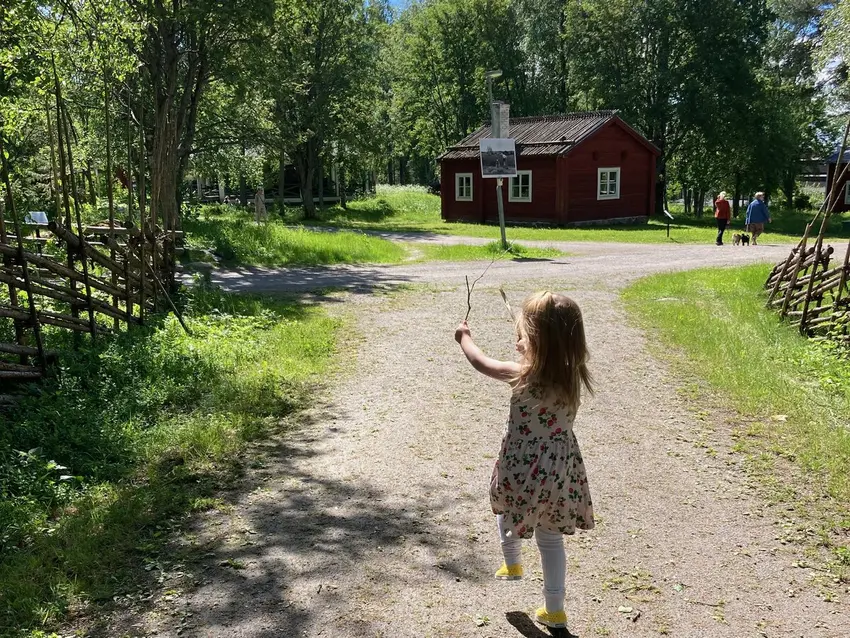
My daughter was four months shy of three years old when we moved from Toronto, and quite verbal for her age; we have videos of her interrupting story time to provide long commentary on Dr. Seuss books – and then wandering around the house quoting them.
All this was in English, like most of the rest of her world. Her father almost always spoke to her in Swedish, so we knew she understood the language, but she'd reply in English.
I don't know why it didn't occur to me that the tables would be turned once we'd settled in Sweden. I guess I thought she'd start speaking more Swedish but would continue speaking English at home, at least to me.
No such luck. It wasn't long after in-schooling (the transition period for kids starting daycare or preschool in Sweden, where the parents join to ease the child in to their new environment) that she switched to round-the-clock Swedish – and got very frustrated when I didn't understand.
I was already in full-time SFI (Svenska för invandrare, the state-funded Swedish course for immigrants) when this happened, but a 40-year-old brain is a whole lot slower than a three-year-old one when it comes to language acquisition.
While I was agonising over how to hear, let alone pronounce, the difference between what seemed like an endless number of Swedish vowels, my kiddo was deploying them all fluently, without a thought.
Despite her verbal fluency, though, she was still just three years old – I don't think she understood the concept of different languages, really, or why Mamma all of a sudden couldn't follow what she was saying. After all, when she had spoken English to Pappa, he, with his many years of working and studying in English-speaking countries, understood perfectly.
For me, there were two elements of this difficulty. The first was the daily grind. As everyone who has tried to learn another language as an adult knows, it takes a lot of mental energy to focus on understanding someone speaking in a new language; it doesn't take long before you feel quite tired and want to take a break.
But when it's your own child, you can't take a break. Of course my husband was often around to help, but not always (and it frankly did not feel great having to turn helplessly to him for interpretation when our child asked me for something). I was the one who picked her up every day from preschool (he did drop-off), and his job required fairly frequent travel.
In those times, I had to learn how to battle my own mental exhaustion from straining to understand whatever I could of what my daughter was saying, while not losing my cool when she'd throw a tantrum out of pure frustration at not being understood – and not understanding why she wasn't understood.
Her small-child frustration took many forms, and evolved over that tough first year. As she got older, meltdowns were (sometimes) replaced by a sort of patronising condescension that, out of the grip of the moment, was pretty hilarious.
To my standard parent-lines – e.g. "Sorry honey, I don't understand some of those Swedish words. Could you say them in English, or try explaining what you mean with other Swedish words?" – she began responding by repeating exactly what she had just said, slowly and loudly, like a stereotype of the worst American tourist.
She also took to telling me that I just had to learn to listen:
"Mamma. Du – måste – LYSS-NA. LYSS-NA, Mamma," she would say, pointing at my ears.
In the trickiest moments, with her in full meltdown mode and me at my most exhausted, I tried to remember to take a deep breath, get her to look at my face, and then say to her, as calmly as possible, "I want to understand. I know it's really frustrating that I don't, but I really want to, and I'm trying my best."
That usually worked. But, as everyone who has had small children knows, whether one has the wherewithal to do what's best is usually not a question of knowledge but a question of how much sleep you've had.
So there was the daily grind – for both of us. Then there was the sadness, for me alone, I think (I hope), from feeling like I was missing out on key parts of her life and development.
I love language – reading and writing, in my native language of English, has always been one of the great joys of my life. Not being able to follow her language development at an age when it was, I knew, expanding rapidly, and simply not hearing my child speak in my native tongue, were sources of real sadness for me.
It's better now. Two years after moving to Sweden, my Swedish is much better – thanks, in no small part, to the sink-or-swim situation at home – and my daughter, now a few months shy of five, has started sprinkling in some English when she speaks to me.
This last development is pretty recent, and it's hard to overstate how much it means to me, even though I now rarely have trouble understanding what she's saying in Swedish. It guess it's called "mother tongue" for a reason.
Comments (2)