
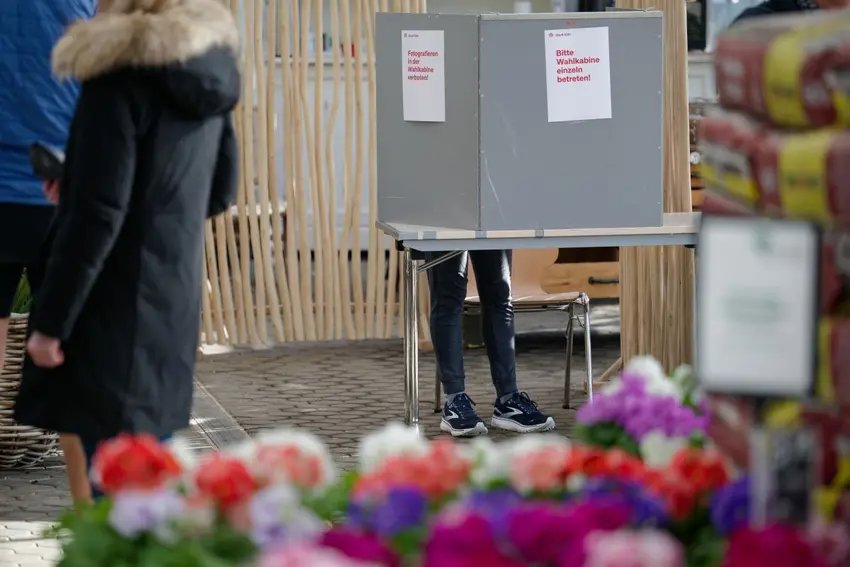
A new proposal by the Left Party would grant voting rights to millions of foreign residents.
At the heart of the proposal is a simple but far‑reaching idea: anyone who has lived legally in Germany for at least five years should be allowed to vote, regardless of their nationality.
According to the proposal, this would apply not only to federal elections for the Bundestag, but also to state and local elections if the necessary legal changes were implemented in cooperation with Germany’s federal states.
If the proposal were to be taken seriously by Germany's governing coalition, the country could be on the brink of a major debate about who gets a say in its democracy. However, it's already provoked strong reactions in the Bundestag.
The motion is expected to be introduced to the Bundestag plenary before the summer recess, with Berlin MP Ferat Koçak leading the initiative.
The reasoning behind the proposal is rooted in what the Left Party sees as a "democratic deficit".
"Fourteen million people live here, pay taxes, raise children and yet are still not allowed to vote," said the party’s deputy parliamentary group leader, Clara Bünger.
She argued that this amounts to "structural inequality", particularly given that all residents are subject to German laws but cannot influence them.
The proposal, she added, is about strengthening democracy by expanding participation and reducing alienation among long‑term residents.
READ ALSO: More than a quarter of people in Germany have an immigration background
How many people would this affect?
The numbers involved are striking. More than 14 million people currently live in Germany without a German passport.
Of these, nearly five million are EU citizens, who already have the right to vote in local elections under EU law.
But the remaining approximately nine million non‑EU citizens are excluded from voting in Germany altogether.

On average, Germany's foreign residents have lived in the country for around 15 years – often without ever casting a vote in a German election, according to the motion filed by the Left Party.
The situation is particularly visible in major cities. In Berlin, for example, of roughly 3.38 million residents aged 16 and over, at least 850,000 are excluded from elections because they do not hold German citizenship.
For the Left Party, these figures underline the scale of the issue: a large segment of society contributes economically and socially but has no direct political representation.
What has the reaction been?
The conservative bloc of Christian Democrats (CDU/CSU) has strongly rejected the idea. CDU deputy parliamentary group leader Günter Krings described it as an “absurd proposal” and warned that it contradicts the constitutional principle that the Bundestag is elected by the German people.
"Democracy literally means ‘rule by the people’ – and not the right to vote for everyone who happens to be present," he said.
READ ALSO: Germany sees 'historic boom' in number of naturalisations
The far‑right Alternative for Germany (AfD) has taken an even harder line, dismissing the proposal as a "typical left‑wing crazy idea".
Meanwhile, the centre‑left Social Democrat party (SPD) has remained notably quiet on the issue. Given that the SPD is governing with the CDU, their silence may reflect a decision to avoid causing political friction with their coalition partners.
The Greens have taken a more sympathetic stance. Filiz Polat, parliamentary secretary of the Green parliamentary group, said, “Anyone who lives here, works here and has become part of this society must not be permanently excluded from politics”.
But she also suggested that expanding participation might first focus on municipal rather than federal elections.
Does the proposal stand any chance of becoming law?
In practice, introducing such voting rights would require a constitutional amendment, meaning a two‑thirds majority in the Bundestag – something that currently appears to be out of reach politically.
The Left Party also raises the possibility that an amendment may not be required because the Constitutional Court could take a more flexible view today than it did in its landmark 1990 ruling.
READ ALSO: EXPLAINED - Who can become a mayor in Germany and what do they do?
Then, the court held that democratic elections must be limited to German citizens, effectively excluding all non‑citizens from voting at federal, state and local level regardless of how long they had lived in the country.
The Left Party suggests that circumstances have changed significantly since then – pointing in particular to Germany’s present character as a country of immigration and the fact that EU citizens have been allowed to vote in local elections since 1992.
But the proposal does not present this as an immediate or clearly defined route to reform.
Comments (3)