
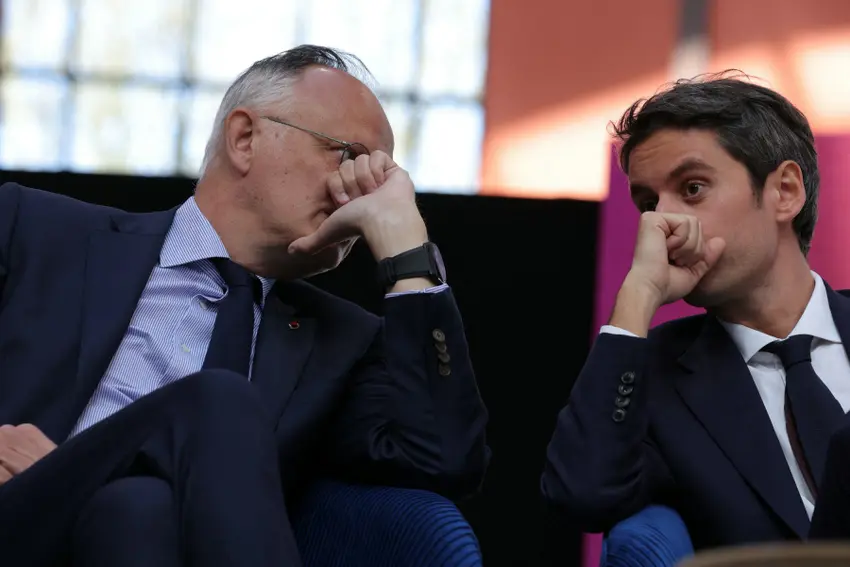
Gabriel Attal was the youngest and one of the most ephemeral Prime Ministers of the Fifth Republic. He spent six months running the government before – to his fury – President Emmanuel Macron called a disastrous parliamentary election in June 2024.
He has since fallen out publicly with his mentor and has published a book this month in which he accuses the President of lying to him about the decision to dissolve the National Assembly two years ago.
Listen to John and the team at The Local France discuss the latest from the presidential election in the latest episode of the Talking France podcast - download here
And yet Attal remains the leader of the party that President Macron founded. He will be confirmed next week as the candidate of Renaissance for next year’s presidential election.
READ ALSO: ANALYSIS: Who's who in France's 2027 presidential election race✎
At 37, he is two years younger than Emmanuel Macron was when he was elected in 2017. He is almost an elder statesman compared to the current front-runner, 30-year-old Jordan Bardella of the Far Right Rassemblement National.
Does Attal, once mocked as a mini-Macron, have a chance of being the next President? Yes, he has a chance but not a very strong one.
He has until early next year to prove that he is a better candidate than his main rival in the centre, Edouard Philippe. If he has not overtaken Philippe in the opinion polls by February at the latest, he will be pressured to step aside in favour of the man who was Macron’s first PM from 2017-2020.
The most recent opinion poll, by Harris for RTL this week, shows Attal up a couple of points at 14 percent and Philippe down a couple of points at 19 percent. Attal has gained ground by annoying his own friends in government by campaigning for bakeries and other small businesses to be allowed to open on May 1st. Philippe has lost some of his bounce from winning re-election as mayor of Le Havre in March. Both are still far behind Bardella on 34-35 percent.
The Attal v Philippe race is a battle-within-a battle but a crucial one. Despite Macron’s unpopularity, the rickety alliance of the Centre that he created nine years ago has the best chance of defeating the Far Right next year – if it can produce a plausible candidate.
I am not alone in thinking that the Left, either hard or soft, would lose to Bardella if its candidate reached the two-candidate second round next May. I see little chance of a migration-obsessed, hard right candidate like Bruno Retailleau managing to unite the Left and Centre to defeat the Far Right.
Neither Philippe nor Attal are ideal candidates.
Edouard Philippe is solid and likeable but charisma-lite. Attal has energy and charm but lacks dignity and gravitas. It would be more fun to have lunch with Attal than with Philippe. It would be less reassuring to imagine Attal dealing with a Putin or a Trump. (Don’t even think of Putin v Bardella.)
Edouard Philippe, who joined Macron from the left of the centre-right, is not a real Centrist. He is a descendant of the Alain Juppé wing of Gaullism – a managerial, socially-minded conservative.
He has yet to say clearly what he would do if he was President. He has promised a list of ideas by the summer.
Attal, who joined Macron from the right of the centre-left, is more of a genuine Macronist, even though the two no longer speak to one another. He wants to push ahead with the Macron Revolution, which he accuses his ex-mentor of fluffing.
In particular, he wants to go further than Macron in making the French work more (later retirement and shorter studies) and letting them keep more of their pay (lower social or pay-roll taxes). That sounds economically sensible but electorally suicidal.
In any case, how can you be an anti-Macron Macronist? It is natural for Attal to distance himself from the unpopular President but his book, En Homme Libre (as a free man), dissolves into ill-judged grudge-settling at times. The book has also been criticised within his own camp for dwelling on the details of Attal’s on-off love affair with the former foreign minister, now EU industry commissioner Stéphane Séjourné.
The resignation on Wednesday of Elisabeth Borne, another ex-Macron PM, from the leadership of Renaissance because of differences with Attal will damage – but not destroy – his presidential ambitions.
Other possible Centrist candidates exist. Gérald Darmanin, the justice minister, has decided not to declare for now. He is talking to both the Philippe and Attal camps, trying to persuade them that there must be a single Centrist candidate by September.
The president of the National Assembly, Yael Braun-Pivet, would like to run but is reluctant to split the centrist camp further. She thinks that ideas and proposals should come before personalities. Good luck with that.
Macron is said to favour his current PM, Sébastien Lecornu who doesn’t want to run and supports his fellow Norman pragmatist, Edouard Philippe.
The idea of a Centrist primary is not yet buried but it is almost certainly dead. The only primary of the Centre will be the public opinion polls.
There is said to be an understanding between the three main political parties of the centre, Attal’s Renaissance, Philippe’s Horizons and François Bayrou’s Modem. There must be a single centrist candidate from February. Whoever is leading in the polls by then should get a clear run to the first round of the election proper next April.
It would be calamitous for two or more candidates to split the centrist vote. Both might be pipped for a place in the second-round run-off by a candidate of the Left – conceivably by the hard-Left Jean-Luc Mélenchon, who confirmed his candidature this week.
But what if Philippe and Attal are neck and neck in the opinion polls into February? What then?
You can find John Lichfield's profile on the candidates of the Left HERE, and the candidates of the Right HERE
Comments