
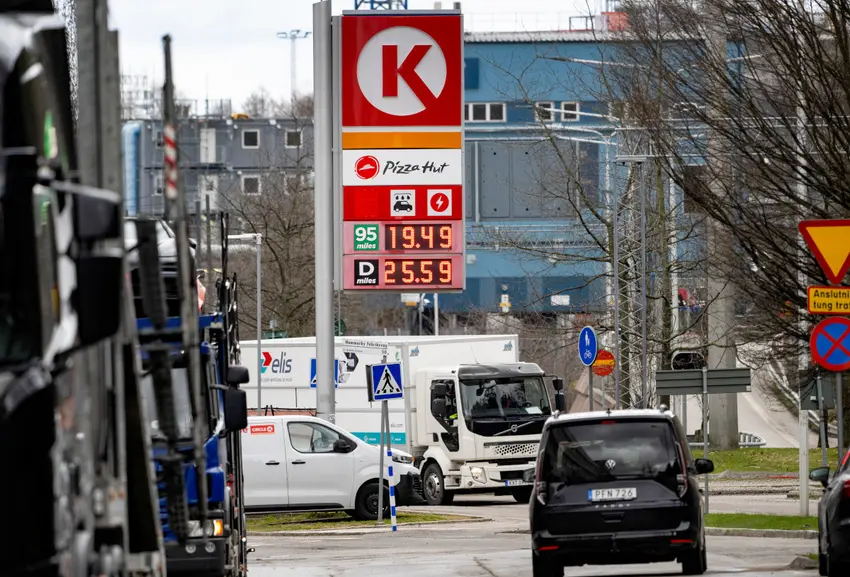
May 1st: Lower fuel prices
Sweden is set to lower taxes on petrol and diesel from May 1st.
The move is part of the government and Sweden Democrats' spring amendment budget and follows skyrocketing prices following the war in the Middle East.
In practice, the government expects prices to fall about 1 krona on petrol and 40 öre on diesel at the pump as a result of the tax cut, which brings it to the EU's minimum level.
It is set to be in place until September 30th and will cost the state 1.5 billion kronor.
The government is also applying to the European Commission for permission to lower taxes even further below the minimum level, by another 3 kronor a litre, if necessary.
May 1st: Tougher rules for foreign criminals who can't get deported
Today, a foreigner who has received a deportation order but who can for some reason not be deported – for example if they are at risk of death or torture in their home country – can receive a temporary residency permit until the deportation can be carried out, which includes a right to work, be registered in Sweden's population register, a right to receive certain social benefits and the ability to travel within the EU.
From May 1st, the government want to make the rules tougher for foreigners who are to be deported because they've been convicted of a crime, or are seen as a security threat. Parliament is expected to vote in favour of the proposal in the coming days.
This would mean that people in this situation are not given a temporary residency permit – instead, an inhibition order from the Migration Agency would suffice.
They could also be banned from leaving a certain area in Sweden, and would have to be staying at a Migration Agency housing centre to be entitled to benefits.
May 1st: Swedish police given power to use AI surveillance
From May 1st it will be possible for the police to use AI surveillance tools for facial recognition in real time, to find victims and prevent and investigate serious crimes.
The proposal is controversial. The government's own inquiry last year pointed out that “the use of such systems is a potentially significant interference in personal integrity as they enable the surveillance of a large number of people”.
The EU also bans countries from using the technology in public spaces, but it is possible to make national exceptions, which is what the government proposed.
It will only be possible to use AI if it is considered “absolutely necessary” to locate or identify an individual. Normally, a prosecutor will have to give permission in advance before AI may be used, but this could also be done within 24 hours in urgent cases.
May 1st and 14th: Public holidays
May 1st, a day for celebrating workers' movements, has been a public holiday in Sweden since 1939. Expect to see rallies organised by left or centre-left parties and organisations, but otherwise not much happens on May 1st in Sweden other than it being a day off for most.
The right-wing parties will still be busy, however, joining everyone else in celebrating Valborg and the King's birthday the day before on April 30th.
Ascension Day, which this year falls on May 14th, is also a public holiday in Sweden. This means Friday May 15th is a great klämdag opportunity, meaning you can book it off to give yourself a four-day weekend and only use one day of annual leave (although your Swedish colleagues probably got there ahead of you and booked it off months ago).
Known as Kristi himmelfärdsdag in Swedish (or colloquially Kristi flygare – "flying Christ"), it marks the day when Christians believe Jesus ascended into heaven. But as Sweden is a relatively secular country you're unlikely to notice anything remarkable unless you're a keen churchgoer – other than getting a day off.
Mother's Day in Sweden falls on the last Sunday of May, this year May 31st. It is not a public holiday (other than being on a Sunday).
May 7th: Sweden's Riksbank to make next policy rate announcement
Sweden's central bank, the Riksbank, is set to announce its next decision on the interest rate on May 7th. The so-called policy rate currently stands at 1.75 percent.
The Riksbank is expected to leave the policy rate unchanged.
Danske Bank recently predicted that it no longer believes that the Riksbank will raise the policy rate in May, but that there will be another two hikes in the near future.
That would mean a policy rate of 2.25 percent in August. Danske Bank's previous forecast had the policy rate at 2.5 percent at the end of the summer.
The policy rate is the Riksbank's main monetary policy tool. It decides which rates Swedish banks can deposit in and borrow money from the Riksbank, which in turn affects the banks' own interest rates on savings, loans and mortgages.
If bank interest rates are high, it's expensive to borrow money, which means people spend less and as a result inflation drops – or if they are low, inflation increases.
May 21st: New rules for work permit holders
On May 21st, Sweden is set to scrap the rule which requires work permit holders to apply for an entirely new permit if they change employer within the first two years.
Instead of applying for a new permit, applicants would simply need to inform the Migration Agency of their change of employer, although failure to do this could lead to their work permit being withdrawn.
The new proposal will also change the rules around trial periods. Currently, the Migration Agency is only able to issue a work permit for the length of the applicants' work contract, which in the case of trial periods is usually less than six months.
Under the new proposal, the agency would be able to issue a permit for longer than six months but for a maximum of two years, with the work permit holder then responsible for informing the agency if the trial period does not turn into a full-time job offer.
On May 21st, Sweden is also expected to extend the three-month deadline for work permit holders who lose their jobs to six months. Many work permits holders and organisations called for this deadline to be extended, including The Local's editor, following the mass layoffs at Northvolt in 2024, but the government said at the time that it wasn't something it was considering.
These proposals still require a vote in parliament, which is scheduled to take place just a few days before, so the exact dates could still change.
Sweden is required to bring in the new rules to comply with a new EU directive adopted in April 2024, aimed at simplifying the process for so-called third country citizens to get work and residence permits in EU member states.
May 21st-22nd: Nato foreign ministers to meet in Helsingborg
Nato foreign ministers are set to meet in Helsingborg in southern Sweden between May 21st and 22nd.
The first day will be an informal meeting, hosted by Sweden, followed by a dinner at Sofiero Palace.
The second day will be a formal Nato meeting led by secretary-general Mark Rutte.
At some point in May: Safety clause to end teen deportations
Sweden's migration minister, Johan Forssell, has pledged to put forward a draft bill in May which would create a respite for young adults affected by “teen deportations”.
The government's draft bill will be on stricter rules for family reunion, which is expected to contain text of a "safety clause" that will allow some young adults to stay in Sweden.
The safety clause would give young people in this situation the possibility to finish upper secondary school and be given “a certain possibility” to receive other permits.
Teen deportations affect young adults who are no longer able to be in Sweden on a parent's permit after they turn 18, but don't meet the requirements for their own permit.
The Local was the first news site to write about the issue three years ago, but it only made it to the top of the political agenda a few months ago after a series of cases were reported in the Swedish media, sparking a public outcry and a government U-turn.
The Migration Agency has paused all teen deportations pending the new legislation.

Comments (6)