
France says that it WILL send ships to escort tankers but only when the “hot phase” of the American-Israeli war with Iran is over.
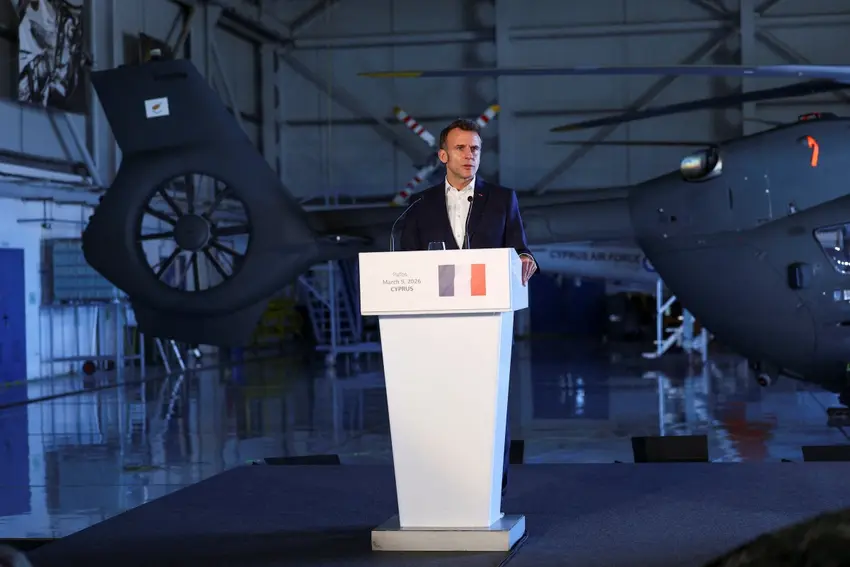
“France did not choose this war. We are not party to this conflict,” President Emmanuel Macron said on Tuesday.
In a telephone conversation with Trump on Sunday, Macron refused to send French warships into the straits under fire – something that the US Navy is also unwilling to do.
Trump said Macron’s response was “not perfect….but this is France, you can’t expect perfect”.
In rambling, self-contradictory comments on Tuesday, Trump said the European refusal was “not a big deal” but a “very big mistake” and “very unfair to the US” which has defended Europe for 80 years. The US did not actually need any ships, just a “few minesweepers”.
Republican politicians say that they have never seen him so angry.
My guess is that Trump knew that there could not be a positive response to his bizarre invitation - more like a command - to Britain, France, Germany, China, South Korea and Japan to re-open the crucial waterway between Iran and Oman.
He is scared. He wants distraction. He wants someone to blame. He wants his supporters to say: “Look, we won the war but those ungrateful European surrender monkeys refused to do the easy part and send ships into a narrow, treacherous strait under fire.”
Trump almost admits as much. We don’t need these people, he said later. This was just a “test” of loyalty - which they failed.
Leave aside Trump’s mafiosi turns of phrase; ignore his tendency to make every issue about himself. What can happen next?
Nothing good and nothing quickly, I fear.
Oil is bouncing around at over $100 a barrel (around €2 a litre for petrol and diesel at the pumps in France). Interests rates are zooming.
READ ALSO: MAP: How to find the cheapest petrol and diesel in France✎
A shortage of fertiliser, which also needs the oil exported through Hormuz, threatens to ruin harvests and make the world hungry later this year. Russia is cackling with pleasure and counting the extra roubles from its oil exports.
Trump’s synthetic anger with Europe may give him the excuse he sought all along to switch sides in the Ukraine war, ditch Kyiv and cosy up to Moscow.
The US and Israel have "won" their ill-considered war but don’t know how to end it. The Israeli Prime Minister, Bibi Netanyahu, is safe from prosecution for corruption so long as his country is at war.
He seems to want to occupy southern Lebanon to prevent further Hezbollah attacks on Israel. Emmanuel Macron promised him a great prize last week, if there was no full-scale Israeli invasion.
In a phone call with Netanyahu, the French president offered to broker a deal in which Lebanon would recognise Israel for the first time in 80 years if the Israeli army pulled back.
This proposal was, it appears, seriously considered in Jerusalem and in Washington (assuming the Trump administration is capable of serious thought). It has not yet officially been rejected but Israel announced a “limited” invasion of Lebanon on Monday and advised 800,000 people to stay away from their homes.
Is President Macron having a “good war”? Arguably, yes. His pro-active but cautious approach has been broadly accepted by the opposition in France, apart from the hard Left.
His rapid deployment of 12 warships in a “defensive” shield for French allies in the Gulf and eastern Mediterranean has made him a hero in the United Arab Emirates and Cyprus.
But the limits of Macron’s and France’s capabilities have also been exposed.
The Rafale jets active over the Gulf states have been firing expensive air-to-air MICA missiles to destroy cheaply-built Iranian drones. The cost has been enormous and France is running out smart missiles.
Each MICA costs an average of €400,000. The French manufacturers have a two-year waiting list for replacements, the financial newspaper La Tribune reported last week.
Macron’s fleet in the eastern Mediterranean has been joined by ships from the UK, Spain and the Netherlands. But what can these ships do other than shoot down drones?
Macron says that they will help to ensure safe navigation in the Straits of Hormuz once the war ends. Their mission is protective and defensive, to give tanker owners and sailors the confidence to sail through the straits as soon as a ceasefire is called.
Fine. But there is no sign of a ceasefire.
What remains of the Iranian regime has few resources to continue the war but does have a fist gripping the world’s carotid artery. They won’t let go easily.
Trump failed to envisage this obvious Iranian riposte. He may have to send the US marines to capture the northern shore of Hormuz, at tremendous potential cost.
The Europeans could try to make a separate deal with Tehran to allow some tankers to pass. But that would take them into direct confrontation with Washington.
Alternatively, and most likely, Trump will declare victory without any clear agreement with Iran. He will claim a huge success and blame the Europeans for his failure.
Dire straits indeed.
Comments