
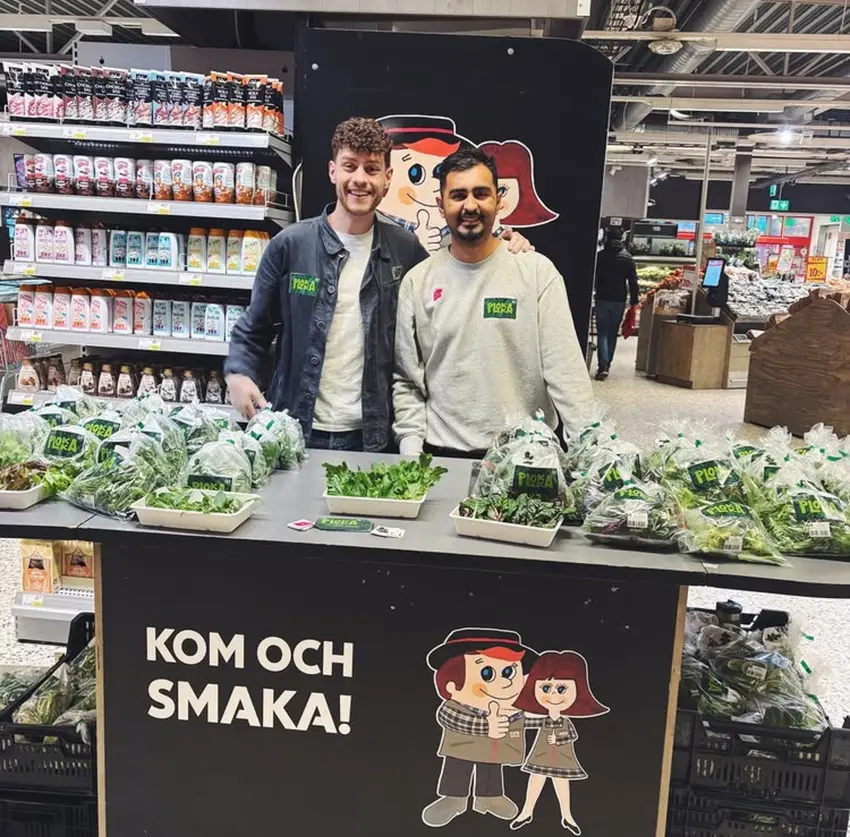
Balasubramanya, known locally as Abhi, came to Sweden in 2021 for an MSc in Sustainable Management at Uppsala University. After completing his degree, he moved to Skellefteå for a job with Northvolt.
But it wasn't long before he started his own business. After his first winter seeing the "rather sad-looking" imported produce on offer in the Swedish north, he began thinking about using the hydroponic expertise he developed in 2022 at Suderbyn (the eco-village on Gotland which ran the Baltic Sea closed loop farming project) as its Applied Research Coordinator, to show that fresh greens could be grown locally in a circular system.
In the autumn of 2024, he was granted a nine-month residency permit in Sweden for people looking to start a new business and soon started Hydro Space Sweden and Plokka, with the aim of using hydroponics technology to, according to Plokka's social media pages, "provide Skellefteå with a reliable, local, and sustainable food source".
Before his residency permit expired in August of 2025, he applied for a business visa on the basis of his new company, which was by then up and running, with a loan secured from Almi, microgreens in production, and key hydroponics equipment on its way.
Everything seemed to be going well until a letter from the Swedish Migration Agency arrived in December, informing him his application was likely to be rejected.
A frantic few months followed, with Abhi doing, he told The Local in a recent interview from Bangalore, everything he could to show the Migration Agency that, contrary to their claims, he did indeed have sufficient knowledge in the hydroponics field and of Swedish, a number of good contacts with potential customers (including the local ICA grocery story), and enough personal finances to support himself while his business got off the ground.
In the meantime, his young business showed every sign of taking off. His first hydroponics harvest was sold at ICA Kvantum in Skellefteå; sales were good, store manager Alexander Björk told The Local, and customers liked the product.
"We built a section for his products in our store," Björk said. "Then they grew more and we started to stock more. We didn't have returns of any of the products. The customers liked it. But [the company] was at the very beginning, so when he started to have more than microgreens, lettuce and so on, we saw that we were selling more and more."
His products also, Abhi said, got great uptake from local restaurants, to which they had sent sample product boxes.
It wasn't enough. He received a rejection decision on his business visa in early February 2026. The rejection decision letter was accompanied by a deportation order, which said he had 28 days to leave Sweden.
There was also the option to appeal, which had to be done within 15 days. After looking into recent cases of other business visa appeals which he thought comparable to his own, and finding out that many were rejected, Abhi decided not to go forward with an appeal.
"I felt I might be buying more time [with an appeal], but it would just be money down the drain, including for lawyers, if rejected," he said.
After looking at the other cases and talking to advisers, he decided that the likelihood of an appeal draining his finances and depleting him mentally, all to no avail, was too high. "I've seen what has happened to other entrepreneurs in Sweden and how many visas were rejected," he told The Local. "I felt quite helpless and I had to make a decision in a short duration of time. So I chose my mental health."
He left Sweden on February 26th and is now back in India. But before leaving, he posted about his experience with the Migration Agency in a LinkedIn post titled "Sweden: Where Innovation Goes to Die in Bureaucracy".
In the post, Abhi calls out "the Swedish 'startup-friendly' image" as "a facade", going on to say that the reality behind that facade is "a Migration Agency characterized by gross incompetence, procedural cowardice, a 'moving goalpost' strategy, and systemic hostility [towards] international talent".
The post gained a lot of traction, garnering over 2300 reactions, 257 comments, and 95 re-posts, at last check. Abhi says a lot of people also reached out to him directly after reading the post, to tell him about their own troubling or disappointing experiences as foreign-born entrepreneurs in Sweden, or to express dismay at the apparent dysfunction of the Swedish immigration system.
In conversation with the Local, Abhi described a stark contrast between the open, helpful, welcoming attitude of the local community in Skellefteå – both businesses and the municipality, including local bureaucracy – and what he experienced as a lack of business understanding from the Migration Agency.
"Skellefteå Kommun were very helpful," Abhi said. "Every time I made a call, they gave me clear information on what I needed to do: what documents to submit, where to apply for various permits, and for funding. The Skellefteå Science City [part of Skellefteå's Innovation Park] was also helpful. Everyone who helped with the company [locally] believed in the vision. It was tangible [for them]. They could see it, touch it, even taste it. It wasn't just words on a paper."
This sentiment was echoed by Alexander Björk (the ICA store manager in Skellefteå):
"We liked that [the products] were grown in Skellefteå. We like when companies run their business locally, and in the winter there's not so much that can grow here. We believed in the idea."
Björk said the local ICA was particularly excited about the planned next stage of production, which was growing strawberries hydroponically in Skellefteå, year-round.
"Then customers could buy strawberries in the winter without so much transportation, without [strawberries] having to travel from Spain," Björk told The Local. "Then in the future [Abhi was planning for] a circular hydroponic system. It was sad that we couldn't go all the way and try all his ideas. It was really sad. He had a great idea. and he couldn't finish it."
In contrast to this enthusiasm from the local business community in Skellefteå, Abhi said that the Migration Agency officer handling his business visa case didn't seem to understand the realities of a startup, nor the high potential value to Sweden of a local hydroponics food supply in the north.
"The case officer had zero business background. It's very strange that someone with zero business experiences is making decisions about business visas," he said.
The whole experience with the Migration Agency was shocking to Abhi, given most of his other experiences in Sweden, which is, he said, "supposed to be one of the nicest safest most secure countries. That's why I wanted to start my business in Sweden".
When he shared the news about the deportation order with his customers, colleagues, and friends in Skellefteå, they were also surprised – and sad.
"Everyone was quite sad and they didn't understand. I received a lot of private messages about how this is not how it's supposed to be [in Sweden]. People were very excited about our products. This was something that was quite unique in the north of Sweden."
Alexander Björk at ICA agreed. "We were a bit surprised," he said, with typical northern Swedish understatement, "because he had a business up and running and the business was growing, and he had support from other parts of the community as well. He's a good guy. It's sad."
Despite the rough exit, Abhi says that Sweden still has a place in his heart.
"Everyone in Skellefteå and Västerbotten was so nice and supportive of my business. I always believe that Swedish people are the most humane and kind-hearted people. I still believe this from the bottom of my heart. But the current government and bureaucracies [are not acting this way], which indicates that the government just wants to show that they've sent X amount of immigrants out, pure numbers. It's not about the value of immigrants."
As soon as he made the tough call not to appeal the decision to deny his business visa, he began looking to sell his company. He found a buyer quickly, he says, for which he is grateful.
"I'm just happy at least someone can take the company forward."
Comments (11)