
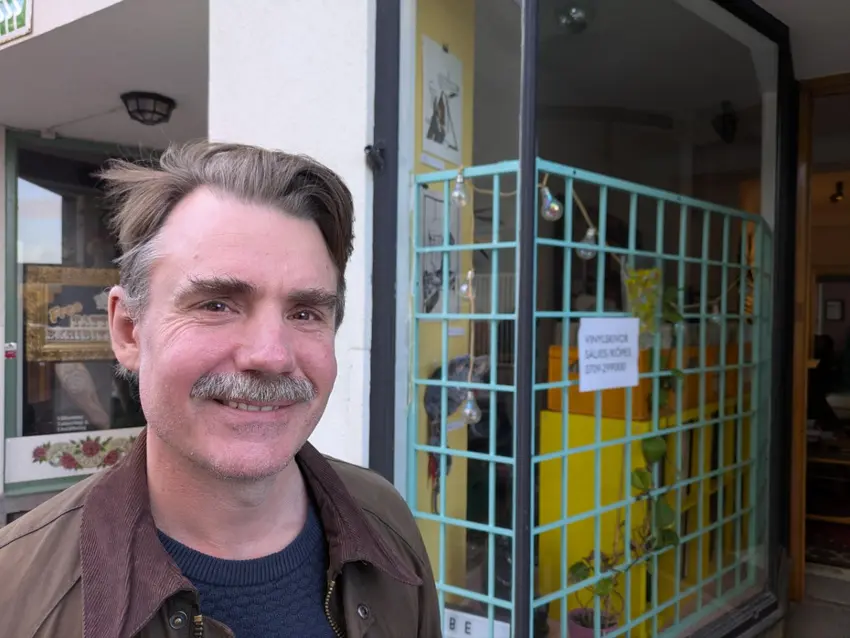
Kopsch says the book, which is due to be released later this March, had its origins in a TikTok post.
"I do a video a day when I'm on my dog walk in Lund, and I try to find different topics to talk about," he explains.
"My son pointed out to me a video from national broadcaster SVT about a guy named Shahdad who came here from Iran when he was 14. Now he's 25 and he was about to be deported, even though his mum has a permanent residency and he had a job, so I did a video on him, because I didn't agree with that."
The video went viral, with a follow-up getting 176,000 views.
"It was a very popular video, but aside from that maybe 100 other people wrote to me who were in the same situation as Shahdad. So then I thought, 'well, this is a rather big issue'."
When he then mentioned the video to his publisher over dinner, someone at the same table said they too had a friend who had been deported and before he knew it, his publisher had commissioned him to write a book.
The timing could not have been better. As the issue of teen deportations has blown up in the Swedish media, putting Migration Minister Johan Forssell under intense pressure to find a solution, Kopsch's publisher is racing to get the book printed and out in the shops ahead of schedule.
"Sometimes you get lucky," he jokes. "When I started work on the book in June, there were no discussions – sporadic news about people being deported, but not much more than that. And then I think, from December, just before Christmas, the discussion started growing, and now it's very big: every day, there's not just one article about someone getting deported, but there are also op-eds in most newspapers."
He puts the rise in interest down to the fact that more and more Swedes are coming face-to-face with the real human impact of the migration reforms of recent years, with even cases that never make the media having an effect.
"For every case, there's a workplace that gets a colleague deported, or a school class or a whole school that gets their classmate deported. And if you add that up over time, you're going to have a lot of really pissed-off people."
READ ALSO: Moderate youth leader confident of solution for Sweden's teen deportations
In the book, Kopsch combines case studies of seven foreigners in Sweden facing deportation with a history of migration policy in Sweden and an economic argument for open borders.
To illustrate how far the political right has swung, he quotes Sweden's prime minister, Ulf Kristersson, arguing in 1989 that borders should be as open as possible, and describes how Migration Minister Johan Forssell back in 2005 led the campaign to give paperless migrants an amnesty.
"It's like a 180-degree turn," he says of the shift.
He puts this partly down to the shift in the political calculus that came after 2015, as public opposition to Sweden taking more refugees rose sharply following the refugee crisis.
But he also blames the simplistic view of migration in Sweden and the way consensus opinion tends to swing.
"We're not very good at distinguishing different types of migration. So if you talk about foreigners in Sweden, people are going to think about refugees from the Middle East. They're not going to think about people coming from Germany working as engineers."
As evidence of Swedish consensus thinking, he points to the furore which erupted in 2014 when the then migration minister, Tobias Billström, tentatively tried to launch a discussion on volumes, on the number of migrants coming to the country.
"There was a ridiculous debate where you were basically called out as being racist if you even tried to criticise migration," he remembers. "And I think in the past few years, we've had the exactly opposite situation. Now you're almost not allowed to say anything positive."
Both Forssell and his predecessor as migration minister, Maria Malmer Stenergard, held press conferences in which they presented statistics showing the number of people leaving Sweden.
"To me, that's a huge change: Ten years ago, you were racist if you talked about the number of people coming here to seek refuge from war, and now it's not racist to say 'look how great we are deporting so many people'."
The book argues that this less humane migration policy has also necessitated a shift in the rhetoric about foreigners.
"Previously, the Moderate Party talked about migrants mostly in positive terms. Now they don't, because you can't. You can't have both those stories at the same time. You can't deport people and say it's important that people come here because it's good for Swedish society. You have to say that they're trying to cheat our welfare system or that they're criminals."
READ ALSO: How Sweden's government ignored warnings when revoking work permit law
Indeed, the position of the right-wing parties has now shifted so far that Kopsch says he no longer really feels at home.
"The left-right span is, for me, mostly about economic issues. So I want low taxes and small government. That makes me right-wing, but now that's not really what people think about when they use the term."
He's particularly incensed about the way the Moderate Party has gone from instituting one of the most liberal labour migration regimes in the world back in 2008 to imposing a minimum salary threshold at 90 percent of the median wage, a policy he argues is completely at odds with orthodox free-market economics the party professes to believe in.
"I don't think that they all of a sudden don't understand economics. It's just the populist thing to do. They are trying to compete with the Sweden Democrats on being against migration."
The underlying idea that labour market migration is a zero-sum game with each foreign immigrant worker taking a job that could have gone to an unemployed Swede, ignores what he sees as an "indisputable fact" that when one person gets a job, that creates other jobs. Employing a foreign chef from overseas, he argues in the book, allows a restaurant to employ waiters.
READ ALSO: Swedish Migration Agency warns against abolition of 'spårbyte' without transitional rules
One of his most illuminating case studies is that of Ismat Musawi, an Afghan stone-cutter who has worked for a granite quarry in northern Skåne for nearly ten years. Before he came to Sweden, his employer, Eric Lundmark, had struggled to find a local willing to train as a stone-cutter, and arranged for Musawi to have a tailor-made course shortly after he arrived in the municipality. Musawi then lost his right to a work permit with the abolition of track change.
"It really points to the grave misunderstanding that the current government has about what specialised workers are," Kopsch says of Musawi's situation. "They've decided that if you make less than 90 percent of the median wage, then you're not a specialised worker, and you should be prohibited from working in Sweden."
READ ALSO: Three years after The Local, Sweden wakes up to teen deportations
He finds it particularly annoying that Forssell continually argues that the government has improved conditions for labour migration by making the (in any case misleading) claim that the government has reduced the waiting time for a work permit to 19 days.
"It's not bad that it takes less than 20 days, but it doesn't really matter, because if you live in a country and you are about to go work in another country, that's not the issue you think about."
Instead, he argues, foreign workers consider things like school quality, work-life balance, how much they can earn and save, and how easy it is to get accommodation.
"I guess he knows that that's the only good thing that they've done on trying to attract foreign workers," he says to explain Forssell's near-daily repetition of the 19-day figure. "And then we deport their teenagers when they turn 18...and that's a pretty big deal-breaker."
READ ALSO: 'If I’d known, I wouldn't have come': How Sweden's teen deportations deter skilled workers
Part of the reason for the recent deportations of well-integrated foreigners is that the government brought in several reforms without any transition rules for those already in the country. Even though government ministers now say these deportations are orimlig or "unreasonable", Kopsch points out in the book that the government was already being warned when the reforms were being considered that this would be the consequence.
The far-right Sweden Democrats even put out a post on Instagram when the track change law was abolished, boasting that it would lead to 5,000 deportations. "It matters which party you vote for," they wrote.
The big proposal in the book is for Sweden to bring in what Kopsch calls an "integration amnesty", which would stop the deportation of well-integrated people hit by the abolition of track change, the higher work permit threshold, or of changed requirements for adult children of permit holders.
He says the Liberal Party has already proposed something similar, suggesting there is support for such a move. Sweden, he notes, has in the past enacted immigration amnesties when undergoing a rapid shift in migration policy, such as in 2005.
"We used to have a system for migration that was very open, and people don't like that, so now we need a new system for migration," he explains. "And in the time period when we move from the previous system to the new system, it creates problems for individuals that fall between the cracks of these two systems. So the amnesty I propose caters to that group. And then we will start out fresh from a new base."
Looking forward, he expects the furore over deportations to have an impact on the coming election campaign, with parties on both the left and the right likely to adjust their messages.
The public anger of the past two months, he argues, has challenged the judgement of the main political parties that the Swedish public wants migration policy to be as strict as possible across the board.
"The political parties have now understood that people don't really see it that way," he says. "The awakening that politicians have had is not that these laws are going to kick out teenagers and people who are working – because they knew that when they changed the law. The thing that they're surprised about is the public reaction and most political parties change if they understand there's something the public wants."
Comments