
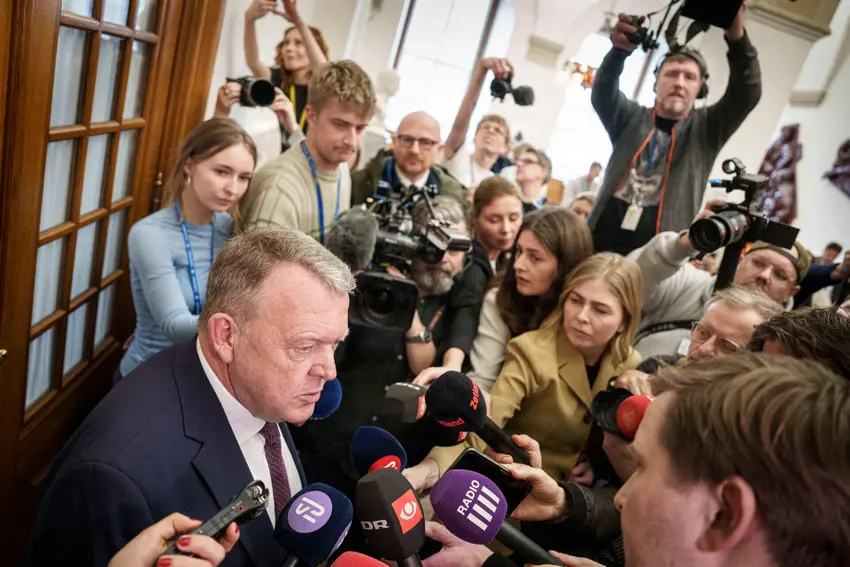
Elections will be held in Denmark on March 24th, Prime Minister Mette Frederiksen announced on Thursday.
"You know what is at stake. Whether I will continue to be your prime minister depends on how strong a mandate you give the Social Democrats in the parliamentary election to be held on March 24th, 2026," she added.
Parliamentary elections last took place in Denmark in November 2022 and were required to take place again no later than October this year.
The decision to call the election comes at a time when the coalition government is experiencing an upswing in the polls, with both the Social Democrats and Foreign Minister Lars Løkke Rasmussen's Moderate party benefiting from mini revivals linked to the response to US President Donald Trump's threats to seize Greenland, an issue which dominated the news in the early weeks of the year.
READ ALSO: Danish government gets poll surge amid Greenland crisis
However, the coalition is still polling some way short of the vote share it received in 2022, and would need to make further gains to secure an overall majority.
“It will now be up to you, the voters, to decide which direction will be set for Denmark for the next four years, and I am really looking forward to it,” Frederiksen said in parliament on Thursday.
Alongside the Prime Minister's party and the centrist Moderates, the coalition also includes centre-right Liberals (Venstre), who are traditionally the main rival of the Social Democrats.
The three parties took office as a coalition in 2022, but Frederiksen offered no guarantees the alliance will continue beyond the vote in March.
Great Prayer Day
With a month until the election, several issues could emerge as both vote-winners and potential wedges that could split parties on either the left, right or centre.
The centre-left Socialist People's Party (SF), which has consistently performed well in polls and put in a strong showing at last year's local elections, have said they will demand the return of the Great Prayer Day holiday as a condition for supporting a Frederiksen-led government.
The popular public holiday was scrapped by the coalition in 2023 in a move it said would boost tax revenue to aid defence spending.
Several opposition parties on the right of the current government, including the Liberal Alliance, Denmark Democrats and Danish People's Party, have also expressed support for a reinstatement of Great Prayer Day, meaning that either a left-wing or right-wing victory could be a potential catalyst for the holiday's return.
Inside Denmark: Could Great Prayer Day make a surprise comeback?
Who will lead the conservative bloc?
While Frederiksen is the only clear candidate to lead a left-leaning government, the identity of a potential new Danish prime minister from a conservative party is so far uncertain.
The most obvious candidate, Liberal leader Troels Lund Poulsen, has yet to explicitly announce his intention to become prime minister. Poulsen is currently a senior member of the government as defence minister.
The current centrist coalition government is actually something of an outlier, with governments usually formed along broad alliances on the left or right.
Denmark's parliament has a multi-party system (there are currently 11 parties in parliament), meaning a single-party majority is essentially impossible.
Usually, the parties are allied in ‘red’ and ‘blue blocs’ which back the leader of the biggest party on either side -- normally the Social Democrats and Liberals, respectively -- to form a government.
Should 'blue bloc' or conservative parties gain an overall majority in the March 24th vote, Poulsen would likely need the confidence of Denmark's far-right, including the Danish People's Party and Denmark Democrats, to be able to succeed Frederiksen as PM.
Poulsen's strategy on how to oppose Frederiksen, his current colleague in government, could have a sizeable sway on voters.
'Bloc politics': A guide to understanding parliamentary elections in Denmark (from 2022)
Meanwhile, a continuation of the centrist coalition, which took office in 2022 isn't out of the question.
“Could it be another government spanning the political centre? Yes. Could it be a government based on the left side of parliament? Yes, if it’s manoeuvrable and capable of working with many parties,” Frederiksen said on Thursday.
“I’m not ruling anything out in advance,” she said.
There is some room for the coalition to evolve, with, for example, the libertarian party Liberal Alliance, a 'blue bloc' party, on Thursday saying it would govern with the centre-left Social Liberals (Radikale Venstre) but not if that coalition was led by the Social Democrats.
Liberal Alliance -- another party which has performed strongly in polls in the current term -- would be prepared to lead the government "if the arrow points towards me," leader Alex Vanopslagh said following the election announcement.
On the other hand, left-wing parties have said they will only back a Frederiksen-led government formed of the 'red bloc', and not including any centre-right parties.
Security and the US relationship
Frederiksen and Løkke have both largely gained credit from the government's handling of US threats to Greenland, while security could prove a major election issue given the huge amount of government spending that has been committed to it.
Denmark must continue to rearm and help protect Europe from Russia, Frederiksen said.
"Security policy is and will remain the very foundation of Danish politics for many, many years to come," she said.
Over the next four years, Denmark will have to "stand on our own feet", she declared, adding that relations with the United States would have to be redefined.
Denmark's relationship with the United States -- which Denmark considers its closest ally -- has been damaged by Trump's desire to seize Greenland.
Cost of living
Despite stable inflation, food still remains a heavy drain on many household budgets, an issue which has given rise to political discussion over how and when VAT on food could be cut.
Denmark currently has a flat rate of 25 percent VAT (moms in Danish) on food, with differing political views on whether to introduce differentiated VAT or a lower flat rate, and the timescale and technical limitations on this.
Any party that can convince the population it will be good for their personal finances is likely to fare well in the election.
READ ALSO: Denmark confirms plan to cut VAT on food but not until 2028
Wealth tax
An emerging issue which has already split the coalition parties is wealth tax, incidentally one of the decisive factors in last year's Norwegian general election.
At the same time as announcing the election, Frederiksen said she was proposing a new wealth tax.
Comments