
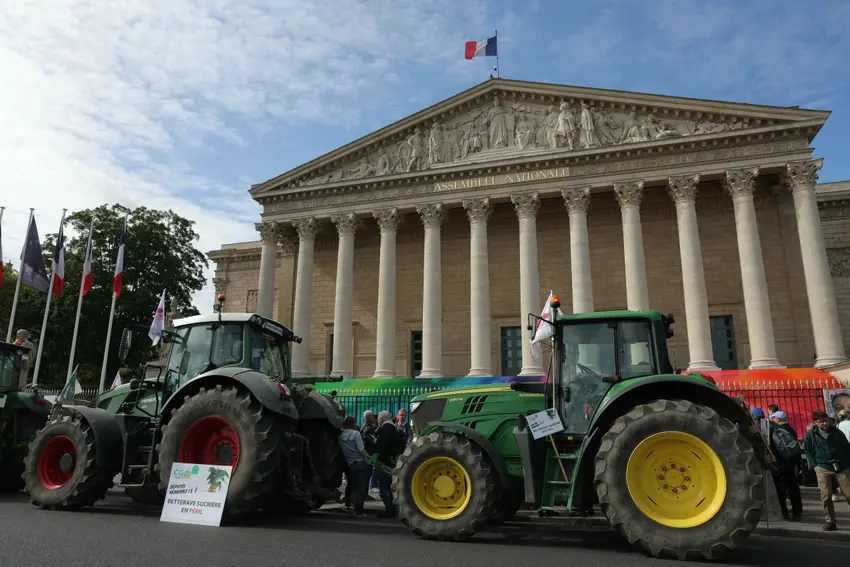
Monday sees the convergence of two nationwide protests in France, both targeting roads. Taxi drivers have decided to extend last week's protests - which are about changes to the fare structure for medical transport - meanwhile farming unions have called for a restart of the protests over a planned new agricultural law.
Debates begin on Monday afternoon in the Assemblée nationale over the Loi Duplomb, aimed at loosening some of the regulations on French farmers over issues such as water and pesticides - it is expected to be fiercely contested, and the farmers' protests are aimed at getting MPs to support it.
Both groups are using the same method - using their vehicles to create blockades or rolling roadblocks (known as opération escargot) to cause severe traffic disruption. Last week, action from taxi drivers caused tailbacks of 450km in the Paris region.
Farmers
Farmers will once again be mounting tractor convoys, focusing on autoroutes and other main roads for go-slow actions.
Monday will see an especially large turnout in the greater Paris region, with the tractors gradually converging on the French parliament in order to stage a protest.
On Monday morning, severe disruption was reported on multiple autoroutes in the greater Paris region, including the RN118, RN12, RN14 and RN20.
In other parts of France, protests are planned at the préfecture - unions in Sarthe, Aisne, Ardennes and Marne have confirmed protest plans, others are likely to follow. It is therefore likely that there will be severe traffic disruption and road closures in the vicinity of the préfecture in multiple towns.
The FNSEA, the largest farming union, is calling for protests in "every département of France" on Wednesday.
However FNSEA boss Arnaud Rousseau said that this time there is "no question of blockading Paris", and the actions would be more symbolic in nature.
Taxi drivers
Last week's protests were initially planned to end on Friday - that was later extended until Sunday and then into this week, after an unsatisfactory meeting over the weekend with prime minister François Bayrou.
Drivers' unions say that this week their blockades will be focused on specific targets - namely Paris' two airports and the Roland Garros tennis ground, where the French Open tournament is currently underway.
"From Monday, in the absence of progress, Paris international airports, Charles de Gaulle and Orly, will be blocked by taxis, and we will also take care of Roland Garros," Emmanuelle Cordier, president of the National Taxi Federation (FNDT), told France Info radio.
Alternatives
These protests are heavily targeted at the road network - so drivers should leave extra time for journeys, especially in the Paris region, and be prepared for delays and traffic jams.
They do not affect public transport, which will run as normal - both of Paris' airports and the Roland Garros ground are accessible via public transport - the airports are connected to the city via RER B, while Orly is also on Metro line 14 and the T7 tram. Roland Garros is on Metro lines 9 or 10.
Although not all taxi drivers are joining the protests it will be likely harder to get a taxi. However TVC vehicles such as Uber, Bolt or Heetch are not involved in the protests - although they practice surge pricing so rides may be more expensive than usual.
Comments (1)