
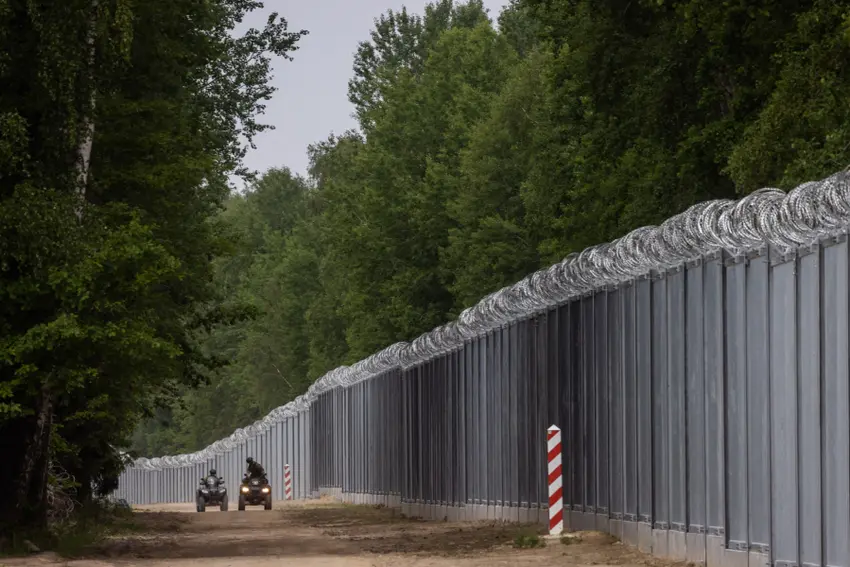
With data showing less than 20 percent of people ordered to leave the EU currently do so, the European Commission unveiled a planned reform of the bloc's return system, including making it easier to lock up irregular migrants.
"We are creating the scope for member states to explore new solutions for return," Magnus Brunner, the EU commissioner for migration, told a press conference in Strasbourg.
A souring of public opinion on migration has fuelled hard-right electoral gains in several EU countries, upping pressure on governments to harden their stance.
Led by hawks including Sweden, Italy, Denmark and the Netherlands, EU leaders called in October for urgent new legislation to increase and speed up returns and for the commission to assess "innovative" ways to counter irregular migration.
Feeling of 'control'
Most controversial is the creation of "return hubs" outside the European Union where failed asylum seekers could be sent pending transfer home.
This is not possible at present as under EU rules migrants can be transferred only to their country of origin or a country they transited from, unless they agree otherwise.
The proposed regulation would allow EU countries to strike deals with other nations to set up such centres.
Agreements will be possible only with countries where human rights "are respected", and minors and families with children will be exempt, according to the text.
"We are creating the legal frame, we're not creating the content," Brunner said of the hubs.
Fraught with legal and ethical concerns, some experts say return hubs are an expensive and impractical idea that is unlikely to see large-scale uptake any time soon despite the commission's proposal.
The text also envisages an expansion of the conditions under which irregular migrants can be detained -- previously a last resort.
Authorities will be authorised to hold up to 24 months those considered at risk of absconding or who pose a security risk, as well as people who do not cooperate with return procedures.
Detention is also possible "to determine or verify" someone's identity or nationality, according to the plan, which needs backing from parliament and member states to become law.
Such measures were "essential" to ensure that the system was not abused and migrants ordered to leave did not move from one member state to another, Brunner said.
"This will give people back the feeling that we have control over what happens in Europe," he added.
'Harmful' proposal
For Jacob Kirkegaard of Bruegel, a think tank, the move on returns reflects a "path of least resistance" chosen by commission chief Ursula von der Leyen about divisive issues that are no longer a priority given the fraught international environment.
Brussels is currently busy dealing with US tariff threats, an aggressive Russia and the prospect of a collapse in transatlantic relations.
But Marta Welander of the International Rescue Committee warned the proposal was likely to result in "families being torn apart, people being held in prison-like conditions" and a heightened risk of rights violations.
"Keeping people deliberately out of sight and out of mind is not a sustainable solution to Europe's migration challenges," she said.
Britain recently abandoned a scheme to deport undocumented migrants to Rwanda, while Italian-run facilities to process migrants in Albania, estimated to cost 160 million euros ($175 million) a year, are bogged down in the courts.
EU officials say the proposed return hubs are a fundamentally different concept -- involving unsuccessful asylum seekers rather than individuals seeking European protection.
But they will conceivably face a similar slew of legal challenges if set up, said Olivia Sundberg Diez of Amnesty International.
"We can expect drawn-out litigation, probably costly centres sitting empty and lives in limbo in the meantime," she said.
Irregular border crossings detected into the European Union were down 38 percent to 239,000 last year after an almost 10-year peak in 2023, according to EU border agency Frontex.
Comments