
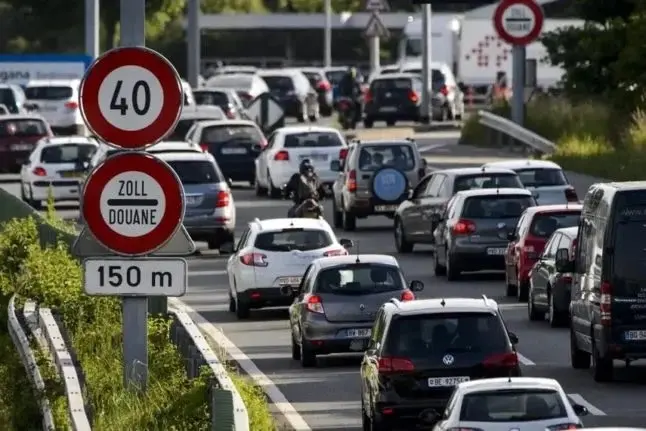
This is what emerges from new data published by the Cantonal Statistical Office (OCSTAT).
These new employees brought the number of cross-border employees in Geneva alone to 112,000 people by the end of 2024. (Overall, over 236,000 commuters from France work in Switzerland's border cantons of Geneva, Vaud, Jura, Neuchâtel, and Basel).
That’s the highest proportion of G-permit holders working in all Swiss regions: about 93,000 from Italy and over 66,000 from Germany.
The vast majority of Geneva-bound workforce commute from the two French regions closest to the canton — Haute Savoie and Ain — and work primarily in sectors such as restaurants, healthcare, retail, and construction.
Why do increasing number of people from France come to work in Geneva?
The most obvious answer is that these employees — called frontaliers — prefer to work in Switzerland because they can earn more than double the salary they would get in France for the same job.
Also, taxes and social contributions are lower in Switzerland than in France.
Earning high Swiss wages in francs while living in a cheaper eurozone country makes financial sense for these employees — as it does for all the cross-border commuters in other Swiss regions as well.
READ ALSO: Who can work in Switzerland but live in a neighbouring country?
A ‘win-win’ situation
While the frontaliers benefit from working in Geneva, so does the canton.
“We clearly cannot do without them,” said Fabienne Fischer, who is charge of Geneva’s Department of the Economy and Employment.
“We saw this during the coronavirus pandemic: it was essential to put in place a whole series of exemptions from the health measures to authorise these workers to cross the border and allow Geneva to continue to function,” she pointed out.
‘Swiss effect’ for neighbouring France
While cross-border workers benefit Geneva’s economy, it is at the detriment of border regions in France.
According to the Tribune de Genève (TDG), the so-called ‘Swiss effect’ — that is, the advantages of working in Geneva and being paid Swiss wages while living cheaper in France — is unfair to those employed across the border “who are paid in euros, and struggle to live and find accommodation in expensive departments because of the ‘Swiss effect’.”
This practice is also unfair "to French employers who, unable to compete against the attractiveness of the salaries offered by their Swiss counterparts, are struggling to recruit," TDG wrote.
Other sectors in neighbouring France are at a disadvantage as well: "The health system of the French border departments, because of caregivers who have left to work in Switzerland. And French and Geneva municipalities, which are suffocating under the heavy cross-border traffic."
In all, cross-border workers "generate too many inequalities and socio-economic tensions, and too much environmental nuisance too,” according to the newspaper.
Comments