
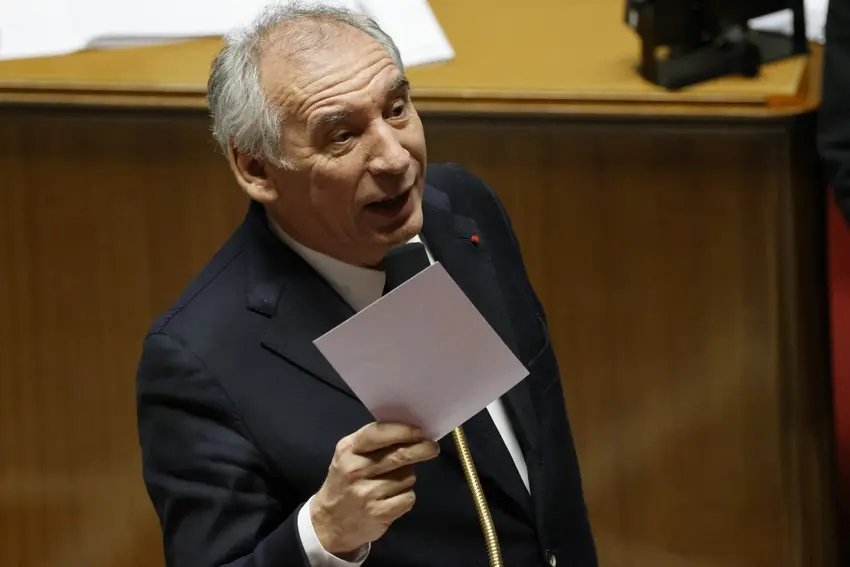
His 90-minute state-of-the-Republic speech to the National Assembly on Tuesday was well written but badly delivered. It contained lots of common sense, some standard waffle, an archipelago of holes and a clever ploy which failed.
Bayrou will probably survive his first censure vote on Wednesday but only because Marine Le Pen’s Rassemblement National has decided not to decide for now. In other words, France’s fourth Prime Minister in 12 months is back in the same impossible position as his predecessor, Michel Barnier, who lasted 91 days.
France does not have a 2025 budget; its deficit is exploding; the economy is slowing; the cost of borrowing is rising. The National Assembly is split into three camps and 11 groups. There is no majority to do anything very much and there is no consensus on how to cut the deficit.
Barnier thought that he could persuade Marine Le Pen to put the country before her short-term political advantage. He was wrong. Her troops joined the Left to vote him out of office on December 4th.
Bayrou believed – and he maybe still believes – that he can take the dagger out of Le Pen’s hand by making a deal with the Socialists. After ten days of negotiations, lasting until just before he stood up to speak at 3pm, he gave them a couple of concessions.
But he failed to give them the “trophy” they needed to justify a split with Jean-Luc Mélenchon’s wreck-it-all hard Left.
The Socialists wanted Bayrou to suspend President Emmanuel Macron’s 2023 pension reform which gradually increases the state retirement age from 62 to 64. Put another way, they wanted the Prime Minister to add €3 billion to the state budget deficit this year before they allowed him to cut it.
OPINION: Pensioners, not immigrants, are wrecking France
At one point over the weekend, it seemed Bayrou might give way. He was shouted down even before he spoke by his own minority coalition of the Centre and Centre-right.
Instead, Bayrou declared on Wednesday that the pension reform would be re-considered in lightning negotiations between trades unions and the employers’ organisation, Medef, starting on Friday. If they could find a different but no-more-costly way of saving the loss-making state pensions system within three months, the reform would be scrapped. If they didn’t, it would continue.
Good offer? A would-be clever one. Some Socialists, including the former President François Hollande, believe that it should persuade the Socialists to ignore the first censure vote and again soon after a revised budget comes before the assembly on January 31st.
At a closed meeting of the 66 Socialist deputies after Bayrou’s speech, the party split in two. Some thought that a moderate, serious party of government (like the Socialists used to be) could not plunge the country into an even deeper political and financial crisis by bringing down another prime minister.
Others said that Bayrou’s offer on pensions was meaningless. The employers’ organisation would block any attempt to scrap Macron’s gradual rise in the retirement age to 64. The talks were programmed to fail.
The Socialists also complained that, despite some concessions on health spending, Bayrou failed to confirm modifications in the Barnier budget that his ministers had promised the Socialists in the days before he spoke. There was no mention of a reversal on cuts in teaching posts. There was no clarity on a new tax on the very wealthy.
The meeting broke up without a decision on whether the Socialists would join Mélenchon’s La France Insoumise, the Greens and Communists in a censure vote on Wednesday. On the TF1 8pm news, the Socialists’ leader Olivier Faure demanded a “clear” answer on pensions by Bayrou.
If the lightning union-employer talks fail (as they will), Faure wants the pension reform to return to parliament in September. This is far more than Bayrou or his fragile coalition are ready to concede – and rightly so. France is confronted with a financial crisis a half-century in the making, as Bayrou explained to the assembly. The €56 billion shortfall in the pensions system (despite the Macron reform) is the largest single part of the problem.
Bayrou will attempt to satisfy the Socialists in other ways before Wednesday's vote. He was mysteriously vague on his 2025 budget plans. He can, for instance, offer reassurances on a tax on the super-wealthy, which is already under discussion.
But he is unlikely to bring the Socialists on-side. They know, or many of them know, that they could lose their seats at the next election – maybe as soon as September – if they have no trophy to brandish for splitting with the wider left alliance, the New Popular Front. Mélenchon’s LFI was already threatening to run candidates against all Socialists who failed to support the censure motion.
Bayrou is likely to survive, for now, all the same. Marine Le Pen’s bloc of 142 far right deputies look certain to abstain at this stage. Without them, the Left do not have the votes to bring Bayrou down.
But the first stage of the revised 2025 budget process is due to go before the assembly on January 31st. Bayrou needs to find concessions in the next two weeks which will persuade either the Socialists or the Far Right to allow his government and the new budget to survive.
As things stand, neither seems likely to put the country’s interests before their own political interests or calculations. The crisis continues…
Comments