
Today is the start of the oxveckorna, or "ox weeks" in Sweden. Trettondedag jul, or Epiphany, on Monday marked the last public holiday until Easter, and many have hammered their finances over Christmas, leaving them no choice but to buckle down and work for the next four months without much in the way of entertainment.
For Sweden's three-party coalition government, 2025 looks like an ox year.
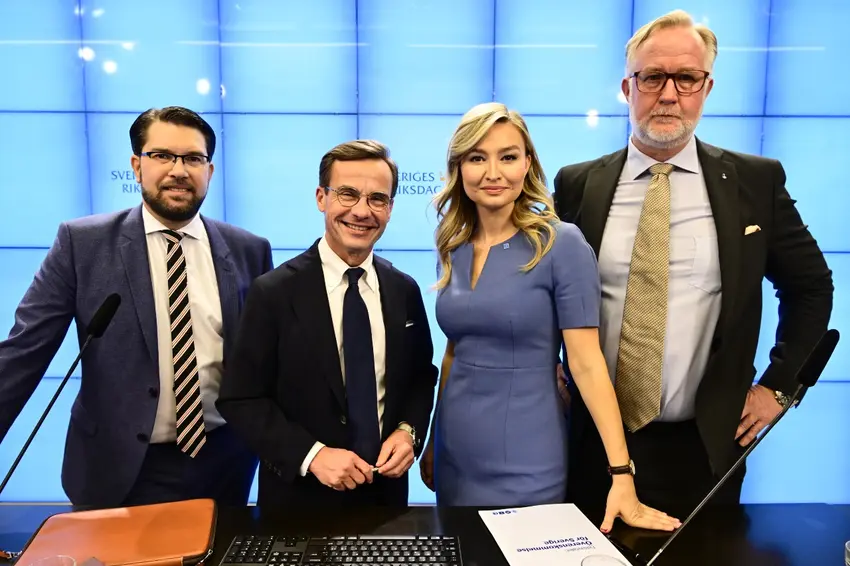
The first two years of ruling with the support of the far-right Sweden Democrats have been surprisingly stable, with the government setting in motion dozens of high profile inquiries on tightening migration and criminal justice law, most of them taken from the Sweden Democrats' policy wish list.
This year, though, is the one where the trickiest proposals need to actually be agreed and passed by parliament.
These include a ban on begging, a law on deporting foreign citizens judged not to have an "upstanding way of life", stripping non-Swedish speakers of their right to a translator when receiving medical treatment, extending the wait for citizenship, and bringing in the so-called "snitch law".
The government parties are divided on all of these. Leading Liberals, such as defence spokesperson Anna Starbrink, have vowed to vote against the begging ban, and argue translators in the health service are a fundamental right.
For the Sweden Democrats, on the other hand, they are an important part of the Tidö project. So who will step down?
With the angiverilagen, or snitch law, the government backed a recommendation from the inquiry chair that teachers, nurses, doctors and social workers be exempted from a proposed new duty to report paperless migrants, giving the Liberals the concession they needed.
Will something similar happen with the other inquiries or will the Liberals instead have to drop their opposition? Or will the government fudge it, putting the proposals through parliament but with so many safeguards that both parties can claim a partial victory?
The risk for the government is that if the Sweden Democrats look like they've lost too many of these battles, they are likely to compensate with more extreme rhetoric and proposals, as we've seen with leader Jimmie Åkesson's recent statements on dual citizens. The Liberals, on the other hand, have arguably been pushed so far out of their comfort zone that there's not much further they can go.
The chances are that the government somehow manages to muddle through to the next election, but if the uneasy coalition were to break down, this is the year when it happens.
This is also the year that the government needs to put its money where its mouth is when it comes to nuclear power. After claiming in the 2022 election campaign that new nuclear power stations would not require much in the way of government subsidies, an inquiry last August outlined a system involving state loan guarantees, a generous guaranteed power price, and a risk-sharing mechanism.
One of the respondents to the inquiry, the Research Institute for Industrial Economics, estimated that, taken together, these could amount to a hefty combined subsidy of 17.2 billion kronor per year for four reactors, with power customers footing 30 percent of the bill and taxpayers the rest.
But despite robust criticism of the proposal from many of the government's own agencies, energy minister Ebba Busch said last year that the government planned to push the system through parliament in May.
The calculation seems to be that if the Social Democrats vote against it, which is likely but not certain, the bill will go through anyway and the government parties will then be able to go into the 2026 election accusing the opposition parties once again of blocking nuclear power.
The question is whether even these generous subsidies will be enough to push Sweden's state-owned power company Vattenfall or its Finnish equivalent Fortum to make an investment decision without a cross-party political consensus. The nuclear argument might not be as convincing in the 2026 election if the government has failed to get the promised "spade in the ground".
When it comes to foreign affairs, the big uncertainties are the new US President Donald Trump and his billionaire backer Elon Musk, as well as Russia.
Musk has in recent weeks been pushing far-right narratives and boosting far-right parties in both Germany and the UK, while Denmark is having to handle Trump's reawakened interest in purchasing Greenland. Some time in 2025, the focus is likely to land on Sweden. When it does, how will Prime Minister Ulf Kristersson and Foreign Minister Maria Malmer Stenergard react?
Russia meanwhile appears to be stepping up hybrid warfare against its Baltic neighbours, with submarine telecoms cables between Estonia, Finland, Germany, Lithuania, Russia, and Sweden cut nine times in just 14 months. Such provocations are likely to continue and perhaps escalate as Russia seeks to test its Baltic neighbours' boundaries. Again, how will Sweden's government, and its new Nato allies, react?
The most recent polls still put the opposition left-wing bloc ahead by 6.2 points.
There is a chance that this calculus could change suddenly if Muharrem Demirok, the leader of the Centre Party, is ousted and replaced by someone willing to take his party into the right-wing bloc. In nearly two years as party leader, Demirok has struggled to bring his party, which used to poll at around 8 percent before the last election, back above 5 percent.
But despite a lot of anonymous briefing, so far, no major Centre Party figure has been willing to come out publicly against him, so while he is still the most vulnerable party leader, he could still easily make it to the other side of the 2026 election.
So the main hope of the government is that as it delivers on some of its most ambitious changes to migration, criminal and energy policy in this "ox year", the opposition's lead starts to evaporate.
There are already some signs this is happening.
The proportion of people who told the Novus polling company that they had either some or a lot of confidence in Ulf Kristersson has risen from 29 percent in January 2023 to 34 percent last October, while confidence in opposition leader Magdalena Andersson has fallen from 54 percent to 42 percent over the same period.
Keeping this trend going will require all the hard slogging the government parties will have to do in 2025 to pay off.
Politics in Sweden is The Local's weekly analysis, guide or look ahead to what's coming up in Swedish politics. Update your newsletter settings to receive it directly to your inbox.
Comments