
Starting in January 2025, 30 new towns will become low-emissions zones, or ZFEs (Zones à Faibles Émissions).
This will bring the total number of towns and cities in France with a ZFE up to 42 while four of the existing city areas will introduce stricter rules on January 1st.
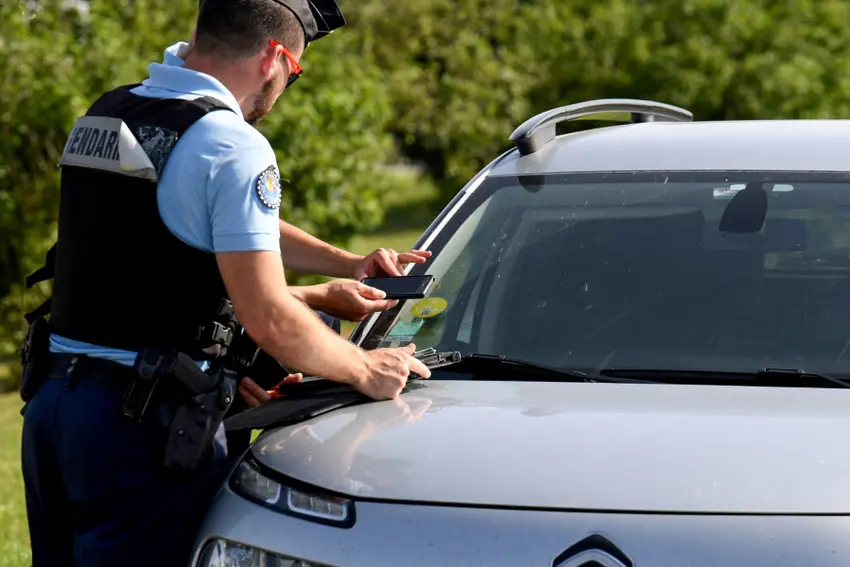
Anyone driving in any of the 42 ZFEs will need a Crit'Air sticker, which denotes the pollution level of your vehicle on a scale of 0 (electric vehicles) to 5 (older diesel vehicles).
These stickers are required for all vehicles - foreign-registered as well as French registered - and must be ordered in advance of the trip. You can purchase one here.
READ MORE: Crit'Air: How France's vehicle emissions stickers work
Failing to display a Crit'Air sticker in a ZFE, or not complying with the restrictions, can lead to a fine of €68 for a light-weight vehicle, or a fine of €135 for a heavy goods vehicle.
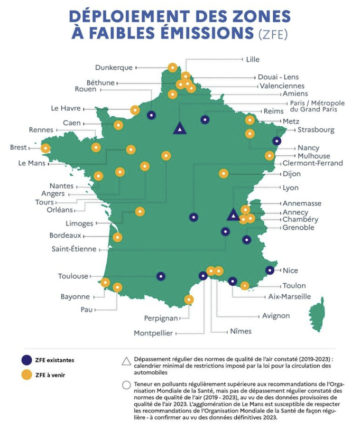
Previously, there were 12 ZFEs in the urban areas of Clermont-Auvergne, Strasbourg, Lyon, Reims, Grenoble Alpes, Greater Paris area, Rouen-Normandie, Aix-Marseille Provence, Nice Côte d'Azur, Montpellier, Saint-Etienne, and Toulouse.
However, starting in 2025, ZFEs will be expanded to the 30 urban areas with more than 150,000 people. This means you will have to have a Crit'Air sticker to drive in the following towns, though some have been allowed to delay introduction.
- Dunkirk
- Lille
- Douai-Lens
- Valenciennes
- Amiens
- Metz
- Nancy (restrictions on heavy goods Crit'Air 5 vehicles)
- Mulhouse
- Dijon
- Annemasse
- Annecy
- Chambéry
- Toulon (restrictions on Crit'Air 5 vehicles)
- Avignon (restrictions on heavy goods Crit'Air 5 vehicles)
- Nîmes
- Perpignan (technically allowed to delay introduction of low emission zone, to be brought in 2026)
- Pau
- Agglomeration of Basque country, including Bayonne and Biarritz (comes into effect in April 2025, restrictions on Crit'Air 5 vehicles)
- Bordeaux
- Limoges
- Orléans (technically allowed to delay introduction of low-emission zone)
- Tours
- Angers
- Nantes
- Le Mans (technically allowed to delay introduction of low-emission zone)
- Brest
- Rennes
- Caen
- Le Havre
- Béthune
What changes are in store?
There are three categories of towns;
Vigilance zones
The 30 towns listed above are classified as 'vigilance zones' - in those areas all vehicles will need a Crit'Air sticker.
'Unclassified vehicles' (those registered before December 31st 1996 and/or light commercial vehicles registered before September 30th 1997, and/or heavy goods vehicles registered before September 30th 2001) are also expected to be banned.
Local authorities can opt to voluntarily increase restrictions (and some chose to ban Crit'Air 5 cars, as shown above), while others have not yet communicated their plans for bringing in the low-emissions zone.
The French government has specified that there will first an education campaign lasting at least three months to inform the public of the changes.
Existing ZFEs
- Clermont-Auvergne
- Strasbourg
- Reims
- Rouen-Normandie
- Aix-Marseille Provence
- Nice Côte d'Azur
- Saint-Etienne
- Toulouse
The above towns or metropole areas (which comprise a town and its suburbs or neighbouring towns) already have ZFEs in place, meaning that a CritAir sticker is required.
There are also restrictions on vehicles with CritAir 4 and 5 stickers - the oldest and most polluting vehicles - although these vary on a local level.
These are also classified as 'vigilance zones', so nothing will change for these towns. Existing restrictions will remain in place but local authorities were not required to add new ones.
Paris, Lyon, Grenoble and Montpellier
Paris and Lyon are considered ZFE 'territories', meaning they regularly exceed recommended pollution levels, so they will have to enact more strict rules.
Grenoble and Montpellier, meanwhile, are not required to enact more strict rules, but have chosen to do so starting on January 1st 2025.
Paris - From January 2025, vehicles with Crit’Air 3 stickers (meaning diesel cars from before 2011 and petrol/gasoline before 2006) will encounter new restrictions when driving in the Paris area. It's important to note that the Paris ZFE covers the city and all of its inner suburbs - extending out to the A86, or outer ringroad.
Crit'Air 3 vehicles will no longer be able to drive within the Greater Paris area's 'low emission mobility zone' (zone à faibles émissions mobilité – usually known by the initialisation ZFE-m) between 8am and 8pm, Monday to Friday.
READ MORE: What you should know about Paris' expanded vehicle ban in 2025
The Paris region has said they would not apply fines during the first year of application, BFMTV reported.
Lyon - Lyon is also enacting a ban on CritAir 3 vehicles and unlike the Paris rule this applies 24/7.
However in Lyon, a 'low mileage' (petit rouleur) exemption will allow residents to circumvent these restrictions up to 52 times per year (with supporting documents, more info here), and commuters can also apply for an exemption. You can see an interactive map of the Lyon low-emission zone here.
Grenoble - local authorities are opting to voluntarily introduce restrictions on Crit'Air 3 vehicles, this covers both the town of Grenoble and 13 communes on the outskirts that make up the Grenoble metropole area.
In these areas, CritAir 3 vehicles will be banned between 7am and 7pm, Monday to Friday - there will, however, be exemptions for locals commuting and for residents to circumvent the restrictions for a limited period. The ban also excludes main roads, namely the A48, RN 481, A480, A41, RN 87, RN 85 and the 'A51. Local authorities in Grenoble have promised a six month 'education period' before they begin imposing fines. Full details here.
Montpellier - another voluntary restriction on CritAir 3 vehicles, this applies to Montpellier and 11 surrounding communes from January 1st, expanding to all of the 31 communes that make up the Montpellier metropole by July 2026.
This will, however, not be enforced by police initially, and exemptions will be possible for locals. Full details here.

Comments (2)