
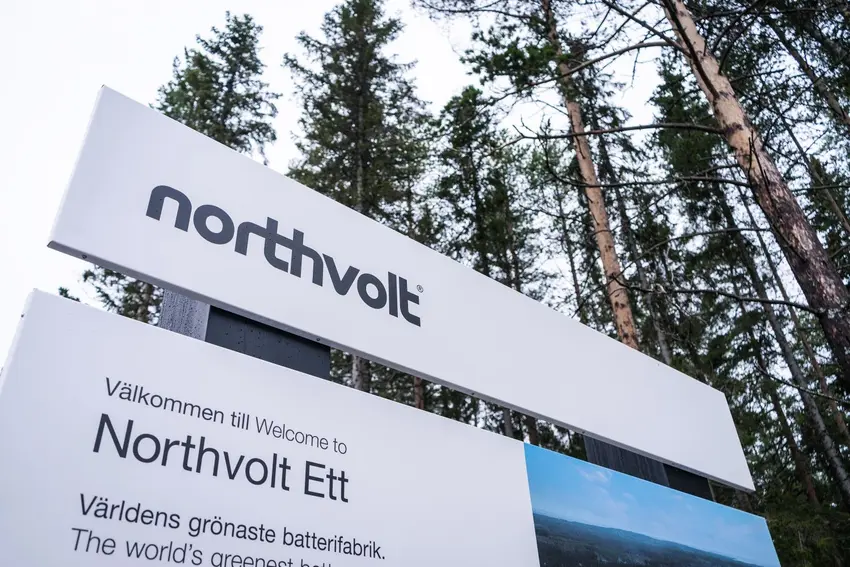
Northvolt Ett, the battery gigafactory built in Skellefteå in the far north of Sweden, produced its first cell in December 2021 but has since struggled to ramp up production, leading to a growing crisis.
Chief Executive Peter Carlsson announced on Monday that 1,600 employees, a quarter of its workforce, would be made redundant and one of its main production lines would be terminated.
The employees, two of whom were senior engineers at the project, did not want to be named for legal reasons and for fear of damaging their future careers.
One engineer, who had a senior role at one of the facilities, said it pained him that thousands of people who had uprooted their lives and moved across the world to be part of the project, now faced being made jobless, while those responsible were for now unscathed.
"It's all well and good to be like, 'oh, we're going to have a strategic review and lay off 1,600 people'. They should be held accountable. This underperformance has one thing in common, and it's the people at the very top."
OPINION:
The Local has spoken to employees who blamed the leadership for launching a series of new gigafactory projects before the first one was even working properly.
A second engineer put the company's problems down to the fact that none of the most senior executives had ever managed a large-scale project before, adding that they had failed to hire project managers at the top level who could make up for this inexperience.
Inadequate planning
Several people The Local spoke to dismissed claims in some Swedish media reports that the problems with the cathode line had been caused by poor quality machines supplied by the Chinese supplier Wuxi Lead.
"I don't think this has got anything to do with the Chinese machines," the engineer said. "I just think it's the way they just sort of whacked everything together in a hodgepodge fashion, without real technical due diligence or putting in the work first. They sort of just bought a bunch of stuff and then tried to cobble it all together. It was just terribly mismanaged."
Instead, the two engineers both said that Northvolt had not done enough preparatory work in the design phase, which had in turn meant that the contracts issued to consultants and suppliers were vague and difficult to enforce.
"It was the way they'd put the structure together for the construction and the commissioning. It wasn't planned," one said.
"The approach was 'just start to build it, we will figure it out as we go'," the other engineer complained, saying that Northvolt's leadership had been in such a hurry to meet deadlines that they had missed many of crucial planning steps.
"Because there was no time for engineering to take place, because timelines were simply agreed to keep the customers happy, many of these steps were omitted," he said.
Lack of skilled staff
Both engineers complained of what one said were "grossly inexperienced" project managers and line managers.
"They just couldn't get the people with the skills. They were just giving away titles, like there would be university graduates with two years' experience, and they'd be the director of some department," one said. "It's ridiculous."
"Unfortunately, the wages were very, very low," the other added, "so typically this offering was accepted mainly by graduates and people looking to enter Europe. This brought with it a lot of inexperience, different cultures or ways of doing project and often language barriers."
Poor contracting
With inadequate planning and a shortage of skilled staff, both engineers argued the contracts with suppliers and contractors were often not drawn in sufficient detail, meaning it was hard to know what was going to be delivered.
"The inexperience at Northvolt meant that contracts were not drawn up correctly, in fact they are hardly worth the paper they were written on. The process of what to actually build was not clear or defined, and there was zero perception of what the timeframe and resource requirements might even look like," one said.
"The deliverables weren't laid out in a contract that you must deliver this and, like, 'here's a list of things that you will deliver'," the other agreed.
READ ALSO:
- Swedish PM says state has 'no plans' to rescue Northvolt
- More than 2,000 work permit holders employed at Northvolt, union reveals
This meant that the major suppliers and contractors to the project quickly realised they could exploit the situation.
"These big design houses, they have strong legal teams behind them, and they are all about contracts: they make bids to win jobs then make money on the extras. Once the foot is in the door, it becomes a free-for-all," one said. "These design houses saw Northvolt coming a mile away. Northvolt somehow decided that contracts would be set up mostly on a time and materials basis, so the companies could sit and burn hours, deliver nothing or very little and Northvolt would still have to pay."
Northvolt response
When the accusations of the former workers were put to Northvolt, the company acknowledged that establishing the factory had not been easy.
"There was never any doubt that establishing a new industry in order to build the world’s greenest batteries in Europe would be a major challenge," the company said in a statement. "We set high ambitions from the start and we have now revised our initial plan so we can build a more sustainable future for the company."
Can the investment be rescued?
One of the engineers said that the design and construction of at least one facility had been carried out so poorly that the company had never been able to get it working while he was there.
"They couldn't get the quality at that part of the factory and I think that's half of the problem," he said.
Northvolt on September 9th announced that it was mothballing the cathode materials production section at Upstream 1, saying that the plant was being placed "into care and maintenance until further notice".
The two engineers were both sceptical over whether this part of the plant could ever be made to work. "You could, but at what cost?" one asked, while the other said that the plant might have to be disassembled and then rebuilt from scratch.
Other employees were, however, more optimistic about the company's future, arguing that the strategic importance of Northvolt to European automotive manufacturers meant that they had little choice to ensure that Northvolt Ett was made to work, even if in the short term, they are slowing the ramp-up of their electric vehicle production. The alternative, one of them said, was to be reliant on Chinese suppliers.
Harald Mix, Chairman of Vargas Holdings, the initial investor in Northvolt back in 2015, said on September 26th that his fund planned to inject more capital into Northvolt to help keep it afloat, making much the same case.
"Most serious observers see what an important role a company like Northvolt has for European competitiveness and the transition in the automotive industry," he told Sweden's public radio broadcaster SR: "I am going to continue to support Northvolt with new capital."
Comments